
Drive down Main Street through The Plains in Kingston in late October and look up. The maples and oaks that make that street one of the best-looking historic streetscapes in New Hampshire are hanging over every roofline, and every one of those roofs has a gutter under it that is full. Same story out on Scotland Road and Depot Road, around Great Pond, and on the wooded lots near the state forest. Kingston is one of the most heavily treed towns we work in, and its gutters pay for it twice a year.
We come into Kingston on Route 107 from our shop in Hampton Falls, and gutter guards are one of the most common things homeowners here ask us about, usually after a fall of cleaning them out every other weekend. Here is our honest take on when guards are worth it on a tree-lined lot, which kind survives oak leaves, maple seeds and pine needles, what they will not do, and what has to be right about the gutter before a guard goes on it.
The short version
- On a Kingston lot with hardwoods or white pines over the roof, gutter guards pay for themselves in ladder trips you stop making and overflow damage you stop repairing. On an open lot with nothing over the roof, save your money.
- The guards that last here are heavy-duty, fastened to the gutter and tucked under the first course of shingles. Foam inserts, brush inserts and thin snap-on covers clog, sag or blow off in the first nor’easter.
- Gutter guards do not stop ice dams. Ice dams start in the attic. Guards keep the gutter from becoming a frozen block of leaves, which is a different problem.
- A guard on a sagging, back-pitched or leaking gutter is money wasted. We check pitch, hangers, fascia and drip edge first, and on many Kingston homes the right answer is new seamless gutters and guards together.
- Guarded gutters still get one look a year. They just stop being a chore.
Why do Kingston gutters clog faster than most towns in Rockingham County?
Other towns on our route have trees. Kingston has trees over the house. The historic homes on Main Street and Bartlett Street were built when the maples out front were saplings, and two hundred years later those maples are forty feet over the ridge. The country roads on the south and west side of town run through hardwood and pine, and the newer neighborhoods off Route 125 were cut into the same woods, so plenty of them kept the big trees along the lot lines.
That gives a Kingston gutter a longer debris calendar than almost anywhere else we work. Maple seeds come down in May and June and mat together in a wet gutter like felt. The oaks hold their leaves longer than everything else and drop them from late October right through the first snow, which is exactly when nobody wants to be on a ladder. White pines shed needles in every month of the year, and needles are the worst of the three because they slide through everything and pack the downspout from the inside.
The other thing the trees do is shade the roof. A shaded, debris-covered roof holds moisture, which is why so many Kingston roofs grow moss and algae on the north slope. We talked about that in our post on roofing maintenance for Kingston homes, and it is also why the gutter protection question comes up on almost every Kingston estimate we write.
Are gutter guards worth it on a tree-lined lot?
We will tell a homeowner no on this. If you are in one of the newer neighborhoods along Route 125 and your lot was cleared to the property line, your gutters will go years without a problem and a guard is a product you do not need. Clean them in the spring and call it done.
The math changes the moment a maple or an oak hangs over the roof. A full gutter does not just drip. It overflows at the low point, usually at an inside corner or above the front door, and the water runs down the fascia and the siding, soaks the ground against the foundation and ends up in the basement. We see rotted fascia boards behind gutters that were only full for one season. We wrote about what overflow does to a house in our post on seamless gutters in Hampton Falls, where heavy coastal rain does the job the trees do here.
Then there is the ladder. Most of the historic homes on The Plains are two and a half stories with gutters twenty-five feet up. We get on those roofs for a living with the right ladder, the right footing and someone else on the ground, and we would still rather you not do it twice a year to scoop out leaves.
What kind of gutter guard actually works with oak leaves, maple seeds and pine needles?
We have pulled every kind of guard off Kingston gutters, so this is not a theory. The foam inserts fill with pine needles and seed husks in a year and turn into a sponge that keeps the gutter wet. The brush inserts hold more leaves than they keep out. The thin plastic snap-on covers from the home center sag between the hangers, collect a puddle of debris in each sag, and the first nor’easter that comes across town at sixty miles an hour peels a few of them off and drops them on the lawn.
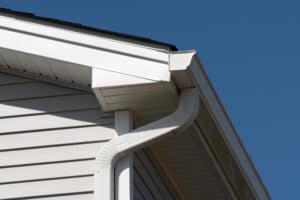
What we install is a heavy-duty guard, fastened to the front lip of the gutter and slid up under the first course of shingles, never nailed through them. It is rigid enough to hold snow load, fine enough that pine needles stay on top, and open enough that the gutter still takes water at the rate the roof delivers it in a downpour. Our seamless gutters and leaf guards page covers the system we use and why we will not install the flimsy versions. Leaves and seeds dry on top and blow off in the next breeze, which is the whole point. The guard fits both 5 inch and 6 inch gutters.
One honest caveat for pine lots. Needles do not go through a good guard, but in a wet fall a mat of needles can build up on top of one, especially on a low-pitch section under a big white pine. The gutter stays clear, which is the thing that matters, but once a year that mat wants to be brushed off from a ladder or rinsed from the roof. We cover that below.
Do gutter guards stop ice dams?
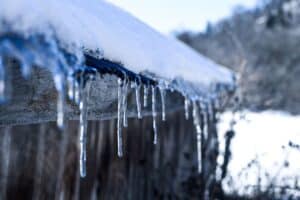
This is the one question we are asked most and the one where a lot of gutter guard marketing goes wrong. A gutter full of frozen leaves is ugly and heavy, and it pulls hangers out of the fascia. A guard prevents that. It does not touch the reason ice forms at the eave, which lives in the attic. Many of the older Kingston homes, the Federal-era and Greek Revival houses on The Plains especially, have thin attic insulation and little or no soffit ventilation, so the roof deck runs warm in January, the snow melts from underneath, and the water freezes when it reaches the overhang.
So when a Kingston homeowner asks us for guards to fix ice dams, we look at the attic first. If the insulation and ventilation are the problem, we say so and we quote that work, because a guard would not have changed the outcome. If the gutters are the only thing freezing, the guard is the right call. We wrote more about the freeze side of this in preventing gutter line freeze-ups in January cold.
Should the gutters be replaced before guards go on?
We are a roofing company that installs gutters, which changes how we look at them. Before a guard goes on, someone from our crew walks the gutter line and checks four things. Does the run pitch toward the downspout, or has it settled into a belly that holds water? Are the hangers holding, or have spikes backed out of the fascia? Is the fascia behind the gutter solid, or soft from years of overflow? Is the drip edge directing water into the gutter, or behind it? A guard fixes none of those. It hides them.
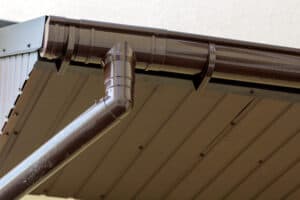
When the gutters are tired, which is most twenty-year-old sectional gutters on a wooded lot, we replace them with seamless aluminum formed on site from Englert metal to the exact length of each run, hung on hidden hangers and pitched to the downspouts. We go to 6 inch on the big roof planes and under valleys that dump a lot of water, and 5 inch where a standard residential run is enough. Then the guards go on new gutters that will outlast them. We also replace gutters as part of most roof replacements we do, because a new roof over an old gutter is a drip edge problem waiting to happen. Old sectional gutters fail at the seams first, and we explained why in where gutter seams fail on aging roofs.
What about the historic homes on The Plains and Main Street?
Kingston’s Main Street is one of the finest collections of Federal and Greek Revival houses in the state. A few of the oldest homes still have built-in gutters, the old Yankee style cut into the roof edge itself. Those are a different conversation entirely, and we have it with the owner before anyone touches them. Most of the houses on The Plains have had hung gutters for a long time, and on those the question is the trim. The crown and the fascia behind a Federal-era gutter are often original, and we are not going to drive a fastener through two-hundred-year-old molding to save ten minutes.
We also pay attention to how the house looks from the street. A white 5 inch K-style gutter suits most of the Greek Revival homes well. On a few houses a half-round profile is the right call for the look, and the guards we use fit either. The goal on a historic streetscape is a gutter and guard you do not notice, doing a job you never think about.
How do we install gutter guards on a Kingston home?
It starts with the walk. We look at every run of gutter, every inside and outside corner, and every downspout, and we note which sections are under a tree and which are not. Then the gutters get cleaned and flushed, because a guard goes over a clear gutter, not a full one, and because flushing shows us where the pitch is wrong.
Downspouts matter more in Kingston than people think. A lot of the country properties here are on septic, with a well, a gravel driveway and a basement, and a downspout dumping against the foundation or across the leach field is a problem no guard solves. We put the outlets where the water can get away from the house, add an extension or a splash block where the grade needs it, and on the historic homes keep the downspout run neat against the corner board.
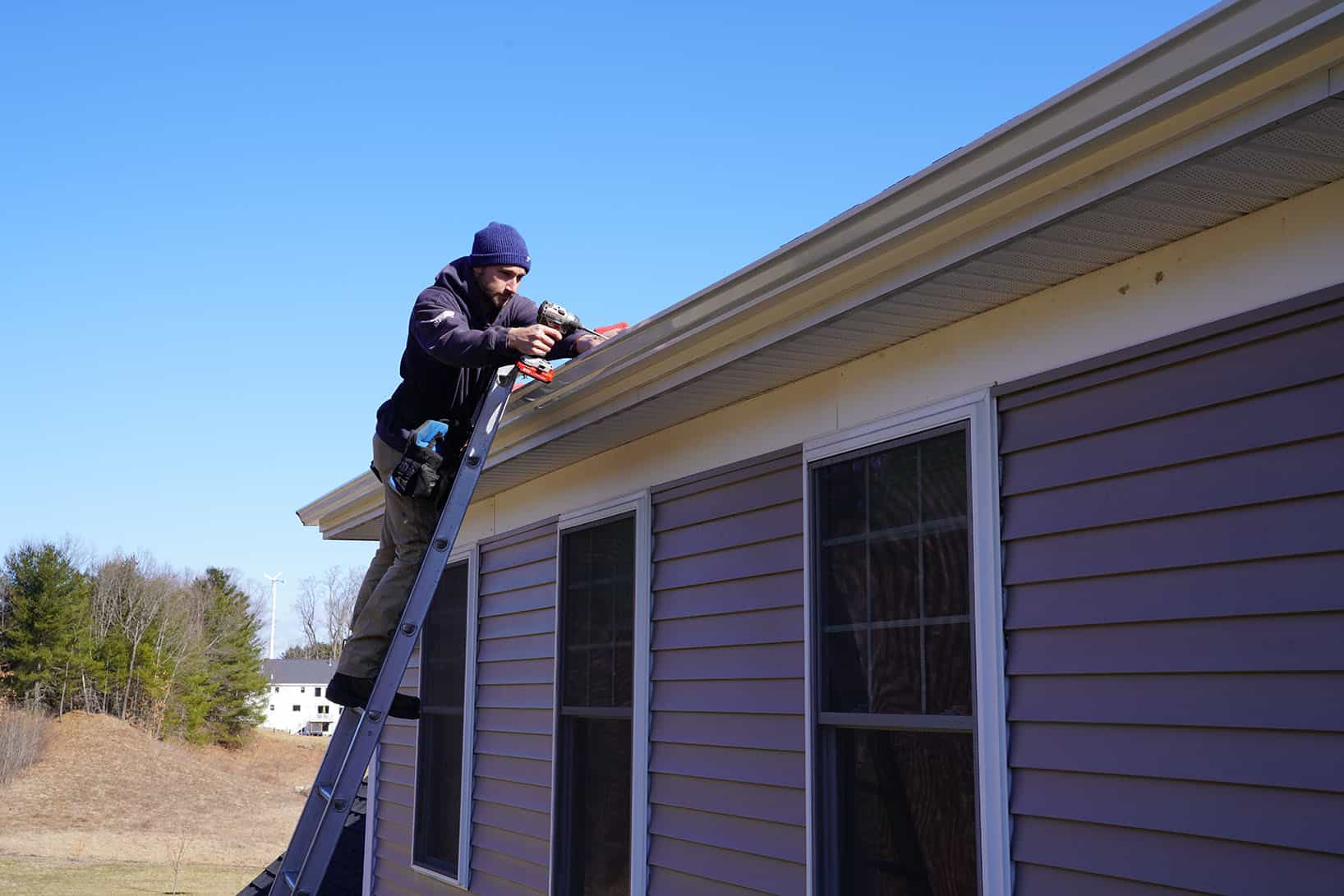
Then the guards go on, screwed to the front lip, tucked under the first course, and overlapped at the joints so there is no gap for a seed to find. The crew that does it is the same crew that does our roofs, so if we find a soft spot in the sheathing at the eave or a drip edge that was never installed, we deal with it rather than guard over it. Most Kingston homes are a one-day job. The big estates with a carriage house and an ell can run longer.
Do guarded gutters still need any maintenance?
Anyone who tells you a gutter guard is maintenance-free has not lived under a white pine. The gutter itself stays clear, which is the thing that saves your fascia and your basement. The top of the guard, on a wooded lot, will collect a layer of needles and husks now and then that a wind or a hard rain usually clears. When it does not, a quick pass with a brush or a hose from the roof edge takes care of it. One look a year is the honest number, and we are glad to do it as part of the roof inspection we recommend on Kingston homes.
What you stop doing is the part that matters. No more two trips up the ladder every fall. No more finding out the gutter was full when water pours over the front door in a December rain. And no more spring surprise, which we described in our post on clearing winter debris from New Hampshire gutters, where the gutter you cleaned in November is packed again by March.
Who installs gutter guards in Kingston, NH?
Gutters and guards are part of our roofing work in Kingston, and the same crews handle both. Because we are a roofing company first, the gutter gets tied into the drip edge and the roof edge the way it should be, instead of hung as an afterthought by someone who never looks at the roof above it.
Two times we will send you somewhere else. If your gutters and guards were installed in the last couple of years by another company, call them first, because the work may be under their warranty and you should not pay us for it. And if your lot has no trees within reach of the roof, we will tell you that you do not need guards at all. Otherwise, request a free gutter guard estimate and we will walk the gutter line with you, tell you what is worth doing and what is not, and put it in writing. If you want to spread the cost of new gutters and guards out, we offer financing on gutter work too. Call us in New Hampshire at (603) 686-7763.
Frequently asked questions
Can gutter guards be installed on my existing gutters?
Yes, if the gutters are sound. We check that each run pitches to its downspout, that the hangers are holding, and that the fascia behind the gutter is solid before we fasten a guard to it. If the gutters fail that check, we will tell you, because a guard on a sagging or leaking gutter solves nothing.
Do gutter guards work with pine needles?
A heavy-duty guard keeps pine needles out of the gutter and the downspout, which is where they do the damage. On a lot with big white pines, needles can build a mat on top of the guard in a wet fall. The gutter stays clear, and the mat brushes or rinses off in a few minutes once a year.
Will gutter guards damage my shingles or my roof?
Not the way we install them. The guard is screwed to the front lip of the gutter and slid under the first course of shingles. We never nail or screw through the shingles themselves, and we do not lift the roofing to do it. On the historic homes on The Plains, we also avoid fastening into original trim.
Can gutter guards handle a nor’easter?
The heavy-duty guards we install are rigid, fastened at the lip and held under the shingles, so wind cannot get under them and snow load does not collapse them. The snap-on plastic covers from the home center are the ones that end up on the lawn after a storm, which is why we do not install them.
Should I get 5 inch or 6 inch gutters with my guards?
Most Kingston homes do well with 5 inch seamless gutters. We go to 6 inch on large roof planes, below valleys that concentrate a lot of water, and on steep roofs where rain comes off fast. Our guards fit both sizes, and we size each run when we measure the house.