
I have replaced roofs from the water’s edge in New Castle to the older streets off Islington, and Portsmouth has a way of finding the weak spot in a roof faster than almost anywhere else we work. It is not only the nor’easters that roll up the coast. It is the salt. Wind carries it off the Piscataqua and the open Atlantic and drops it on everything: fastener heads, flashing, the cut edges of panels, the thin coating on a bargain gutter. Give that a few winters and you can watch a roof age in fast motion.
That is the real reason so many Seacoast homeowners ask us about metal. Specified correctly, a metal roof shrugs off the exact conditions that chew up ordinary roofs here. Specified poorly, salt works under a cheap coating or into the wrong fastener and you are back up a ladder in five years. This guide covers what actually matters for metal roofing in Portsmouth: which metals and coatings survive salt air, why standing-seam beats the cheaper panels near the coast, how long it lasts, and where the money really goes.
The short version
- On the Portsmouth coast, airborne salt is the single biggest thing shortening a roof’s life. It attacks fasteners, flashing, and panel edges long before the roof field itself wears out.
- Standing-seam metal with concealed clips outperforms exposed-fastener panels near the water, because it hides the exact parts salt corrodes first.
- Aluminum and PVDF-coated (Kynar 500) steel are the coastal-grade choices. Stainless or coated fasteners are not optional this close to the Atlantic.
- A properly specified coastal metal roof commonly lasts 40 to 60 years, two to three times a standard asphalt roof, which is why homeowners weigh the higher upfront cost against decades of not reroofing.
Why is salt air so hard on Portsmouth roofs?
Salt air carries chloride particles that pull moisture onto metal and speed up corrosion. On the Portsmouth coast that means fasteners, flashing, drip edge, and cut panel edges can rust and loosen years before an inland roof would, even while the main roofing material still looks fine.
Chloride is the culprit, and it does not need a storm to work. Even on a calm day near the coast, fine salt rides the sea breeze inland, settles on a roof, and holds moisture against every metal surface it touches. That constant damp-salt cycle is what corrosion feeds on. A roof three miles inland in Epping and a roof two blocks from the water in Portsmouth are living in two different climates, even in the same county.
The pattern is the same on almost every Seacoast home. The big field of the roof is usually not the first thing to go. The small metal parts are. Nail heads back out, flashing at the chimney and valleys corrodes and weeps, and gutter spikes rust until the gutters sag and pull away. By the time you spot a ceiling stain, salt has often been working on that metal for years. Understanding that is the whole key to a roof that lasts here.
Does metal roofing actually hold up better near the coast?
Yes, when it is built for salt exposure. Coastal-grade metal resists the moisture, wind uplift, and UV that wear out asphalt fastest here. The catch is that a generic metal roof is not automatically coastal-grade. The metal, the coating, and the fasteners all have to be chosen for salt air.
Asphalt has a hard time on the immediate coast. Sun and salt strip the protective granules, wind lifts the tabs, and our winter freeze-and-thaw swings open up the seams, so a lot of asphalt roofs in full coastal exposure are asking for replacement in fifteen to twenty years. Metal has no granules to lose, sheds water and snow cleanly, and carries far higher wind ratings, which matters when a coastal gust event comes through.
The important word is when. The metal roofs I have seen fail early on the Seacoast almost always came down to the wrong materials for the location: bare galvanized steel instead of aluminum or a coated product, standard screws instead of stainless, or a builder-grade paint that salt ate through. Metal is the right answer near the coast, but only the coastal-grade version of it.
Standing-seam or exposed-fastener: which belongs on a Seacoast home?
Standing-seam. Its seams lock together and its fasteners hide under the panels, out of the salt and weather. Exposed-fastener panels put hundreds of rubber-gasketed screws face-out into the salt air, and those gaskets and screw heads are the first things to fail on the coast.
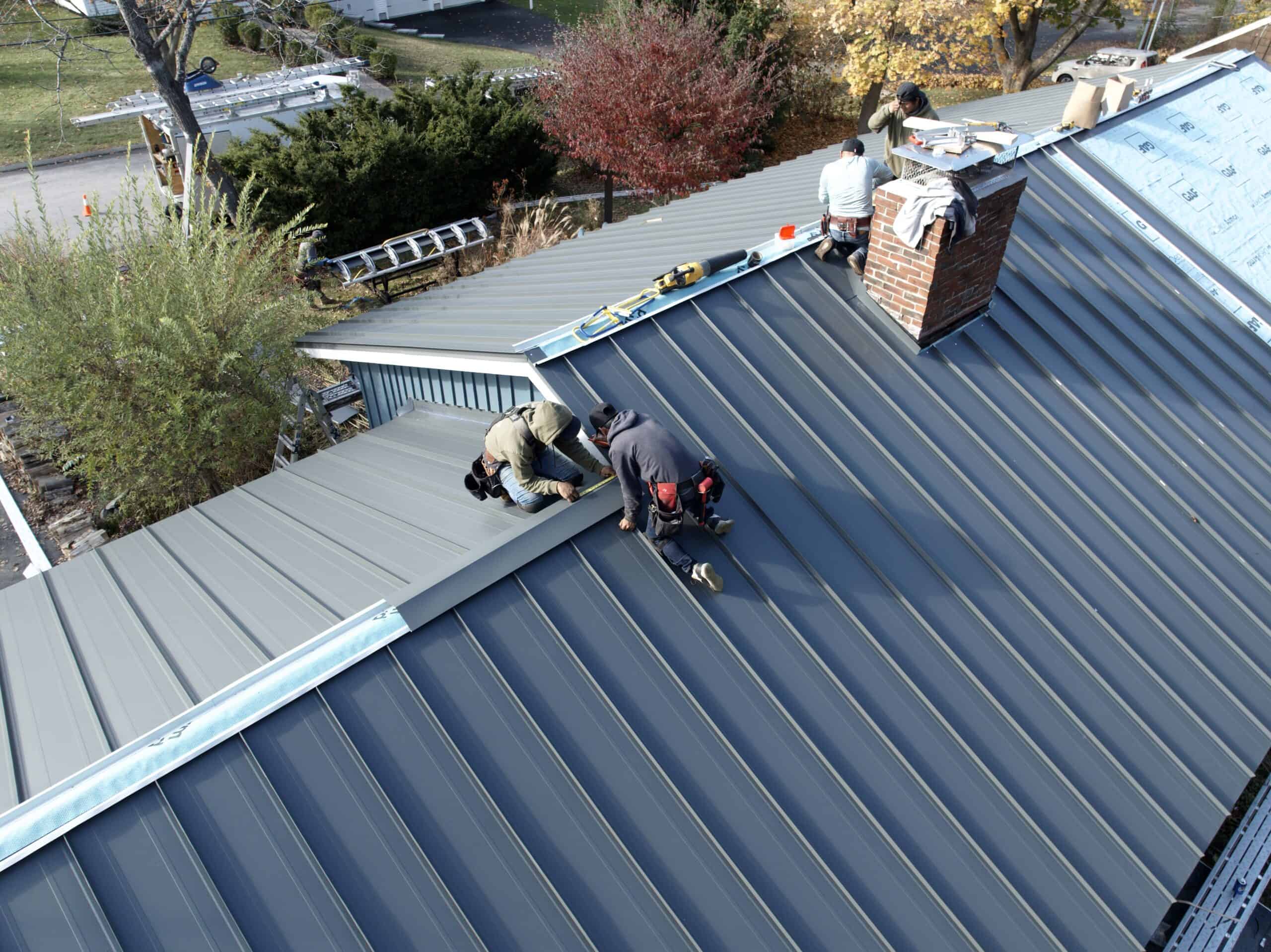
There are two broad families of metal roofing. Exposed-fastener panels screw straight through the face of the metal, with a rubber washer under each screw head to seal the hole. Standing-seam panels lock together along raised vertical seams and attach with hidden clips, so no fastener ever faces the weather.
On the Portsmouth coast that difference is the whole ballgame. An exposed-fastener roof can carry hundreds of screws, and every rubber gasket sits out in the salt air expanding and contracting until it hardens, cracks, and lets water past the head. Multiply that by a few hundred screws and a couple of decades of salt. A standing-seam roof simply does not give salt those targets. It costs more to install, and near the water it is the version I recommend almost every time.
Which metals and coatings resist salt corrosion best?
Aluminum handles salt air best because it does not rust, which makes it a favorite on oceanfront homes. For steel, look for Galvalume with a PVDF (Kynar 500) finish. Pair either with stainless or coated fasteners. Bare galvanized steel and low-grade paint do not belong on a Portsmouth roof.
Aluminum is the standout for the toughest coastal exposure because it does not rust the way steel can, so on homes right along the water it is often the material I steer people toward. It carries a premium, but so does replacing a corroded roof early. For steel panels, the coastal-grade choice is Galvalume, an aluminum-zinc coated steel, finished with a PVDF paint system most people know by the Kynar 500 name. That finish holds its color and sheds salt for decades, which the cheap polyester paints on discount panels do not.
Fasteners and flashing deserve the same care as the panels, because they fail first here. This close to the Atlantic we use stainless or coated fasteners and keep the metals compatible, so salt cannot set off galvanic corrosion where two different metals meet. Driving plain steel screws into aluminum near saltwater is a recipe for a stain and a leak. These details never show up in a glossy brochure, and they are exactly what separates a coastal roof that lasts from one that does not.
How long does a metal roof last in Portsmouth’s climate?
A correctly specified coastal metal roof commonly lasts 40 to 60 years on the Seacoast, against roughly 15 to 25 years for asphalt in the same salt and storm exposure. The variable is usually not the panels. It is whether the flashing, fasteners, and coating were chosen for salt air.
Give a standing-seam aluminum or Kynar-finished roof the right fasteners and flashing, and it can outlast the time most families spend in a house. Maintenance is light: keep the gutters clear, rinse off heavy salt buildup when you can, and have the flashing and seams looked at every few years.
One piece of fine print is worth reading first. Some metal roofing warranties reduce or void coverage within a set distance of saltwater unless you upgrade to coastal-grade materials. That is not a reason to avoid metal. It is a reason to make sure the roof going on your Portsmouth home is the version the manufacturer actually stands behind near the coast. We read those terms with you so there are no surprises.
What does a metal roof cost in Portsmouth, and is it worth it?
Metal costs more upfront than asphalt, and the coastal-grade materials add to that. Where it pays back is time. One metal roof can outlast two or three asphalt roofs, so Seacoast homeowners who plan to stay in their home often come out ahead over the life of the house.
I am not going to hang a fake price on your roof, because an honest number depends on real details: the metal you choose, the size and pitch and complexity of the roof, whether the old roof needs a full tear-off, and the coastal-grade materials the location calls for. A simple Cape and a cut-up Victorian with multiple valleys are not the same job, and anyone quoting a firm price sight unseen is guessing.
What I can tell you is how to think about it. Metal is a bigger check today and a smaller total over the decades you own the house, because you are buying one roof instead of two or three. For homeowners who plan to stay, that math usually favors metal near the coast, and financing can spread the upfront cost. If you are still weighing options, our breakdown on choosing between asphalt and metal is a good next read, along with our notes on keeping a metal roof in shape.
Getting your Portsmouth metal roof done right
A metal roof is one of the best investments you can make on a Seacoast home, but only when it is specified and installed for salt air from the first fastener up. We install roofing in Portsmouth and across the New Hampshire coast every season, so we know what these conditions do to a roof and how to build one that stands up to them. Take a look at our full range of roofing services, or reach out for an estimate and we will walk your roof with you.
Frequently asked questions
Can I put a metal roof over my existing shingles?
Sometimes it is allowed, but on the coast we usually recommend a full tear-off. Going over old shingles hides the flashing, fasteners, and decking, which are exactly the parts salt attacks and the parts we want to inspect and replace before a new roof goes down. A clean deck is also the best base for a standing-seam system.
Are metal roofs too loud in coastal rain and storms?
No. A metal roof installed over solid decking and underlayment is about as quiet as any other roof. The drumming sound people picture comes from metal laid over open framing, like a barn or a shed, not a modern home installation.
Will a metal roof help with ice dams in the winter?
It helps. Snow tends to shed off a smooth standing-seam roof rather than pile up and refreeze, and a properly vented, well-flashed metal system gives ice fewer places to grab. Good roof ventilation and flashing still do most of the heavy lifting against ice dams, on any roof material.
Do coastal metal roofs really need special fasteners?
Yes. This close to the Atlantic we use stainless or coated fasteners and keep the metals compatible to prevent galvanic corrosion. Standard fasteners are one of the most common reasons a metal roof fails early near saltwater, which is why we never cut that corner on a Seacoast job.