
Most of the commercial roofs in Portsmouth are ones you never see. The brick blocks around Market Square and down Bow Street hide low-slope roofs behind their parapets. The plazas along Lafayette Road and the Route 1 Bypass run long flat roofs loaded with rooftop units. Out at Pease, the old air base turned business park, there are single-story buildings with more roof than some of the downtown blocks have floor space. All of it is flat or close to it, and all of it sits a mile or two from open salt water.
We are fifteen minutes down Route 1 in Hampton Falls, and commercial flat and low-slope work is a large part of what our crews do between the residential seasons. Here is how we think about Portsmouth’s commercial roofs: which membrane belongs on which building, what the harbor weather does to them, how we decide between a repair, a coating and a tear-off, and how we keep a business open while the roof comes off over its head.
The short version
- EPDM rubber is the right membrane for most Portsmouth commercial roofs. TPO earns its place over conditioned space where a white reflective roof helps, and modified bitumen on small, crowded roofs with a lot of penetrations.
- Harbor wind, salt and drifted snow attack a flat roof at its edges, corners and curbs first. The field of the roof is usually the last thing to fail.
- No honest recommendation comes before a moisture check. Dry insulation under a tired membrane is a coating candidate. Wet insulation under anything is a tear-off, and no coating or overlay changes that.
- The written scope covers insulation and R-value, drainage, every penetration, the edge metal and the code, with a per-sheet price for deck replacement named up front.
- Downtown jobs are planned around the sidewalk, the street and the tenants below. Pease jobs are planned around the size of the roof and the wind. Either way the building stays open and is never left uncovered overnight.
Why are so many Portsmouth commercial roofs flat or low-slope?
Downtown, the three and four story brick buildings that went up after the 1813 fire were built with low-slope roofs behind parapets, drained by internal drains or scuppers through the parapet wall, and reached through a hatch. Today those buildings carry restaurants on the ground floor, offices and apartments above, and a roof deck crowded with condensers, exhaust fans and whatever the last tenant left up there.
The Route 1 corridor is a different animal. The plazas and standalone shops along Lafayette Road and Woodbury Avenue went up from the 1960s on with long, low-slope roofs, a rooftop unit for every tenant, and drains sized for the roof, not for the leaves that come off the trees behind it every October.
Then there is Pease. When the air base closed and became the tradeport, it filled with office, light industrial and warehouse buildings, many of them single-story boxes with acres of membrane. The access is easy. The exposure is not. There is very little between those roofs and the wind coming up the river.
EPDM, TPO, or modified bitumen: which membrane belongs on a Portsmouth building?
We do not pick a membrane by what is on the truck. We pick it by the deck, the insulation, how the roof drains, what goes on inside the building and what the owner wants to spend over the next twenty years. On a downtown brick building with an old plank deck, black EPDM is usually the answer: it is the most forgiving membrane we work with, and when a seam opens in year fifteen it is a repair, not a crisis. Our page on EPDM and TPO membrane systems goes into the details of each.
TPO is white and reflective, and its seams are heat-welded rather than glued. On a Pease office building that runs air conditioning all summer, a white roof takes real load off the rooftop units. The trade-off is that a TPO roof is only as good as the person running the welder, and a cold, windy day on the tradeport is a hard place to run one, so we schedule TPO work with the weather.
Modified bitumen earns its spot on the small, awkward roofs: a downtown addition with six pipes, two curbs and a chimney in four hundred square feet. The base and cap sheets flash around that kind of clutter more cleanly than a single-ply sheet does. On a large open roof there are better choices.
One thing we will not do is talk an owner out of a roof that is still working. A thirty-year-old EPDM roof that is dry, has one layer under it and shows a few tired seams does not need to come off because it is thirty. We explained what the usual warning signs mean, and which ones are cosmetic, in our post on why a rubber roof bubbles.
What does Portsmouth’s harbor weather do to a flat roof?
Wind uplift is the one owners underestimate. Wind does not hit a flat roof the way it hits a pitched one. It goes over the parapet, drops into a low pressure zone behind it, and tries to pull the membrane up from the corners inward. On a waterfront building or an exposed box at Pease, the corners and perimeter need more fastening than the field, and the edge metal has to be rated for it. Cheap edge metal is where a lot of commercial wind damage starts.
Salt does the quiet work. Downtown roofs sit a few hundred yards from the harbor, and every fastener, every piece of coping and every pitch pocket collar on them breathes salt air. Metal that would last decades inland can rust through in far less time on a harbor-side roof. On a replacement we spec the edge metal and fasteners for a coastal roof, and on a repair we look hard at what is already corroded before we assume the membrane is the problem.
Snow is the load nobody sees from the street. Wind blows it across the roof and piles it against the parapet, the rooftop units and the stair bulkhead, where it sits in a drift long after the rest of the roof has cleared. That drift freezes and thaws against the base flashing every sunny afternoon through March, which is where a lot of the leaks we chase in April started. We wrote about that cycle in why flat roofs are prone to winter leaks, and the spring half of it in how spring rain finds a flat roof’s drainage flaws.
On ponding the rule is simple. Water that drains within about two days of a rain is normal. Water still standing after that adds weight, cooks the membrane in summer and freezes solid in winter. Usually the fix is a drain that needs clearing or a low spot that wants tapered insulation, not a new roof.
Repair, coat, or replace: how do we decide what a commercial roof needs?
This is the decision that matters most, and the one most often made wrong from the surface. A membrane can look rough and be perfectly dry underneath. It can also look fine and be sitting on insulation that has been soaking since a drain clogged two winters ago. We cut a small core, or scan the roof, and let that answer the question. It takes an hour and it is part of the free inspection.
When the roof is dry and the membrane is simply old, a fluid-applied coating is the honest cheaper option and we will say so. The GAF HydroStop coating system goes on with our own sprayers, seals the seams and flashings, and gives an aging roof a new waterproof surface and a warranty without a tear-off or a dumpster. It suits a lot of Route 1 plaza roofs where the owner needs ten more years, not a new roof. What we will not do is coat a wet roof. A coating over saturated insulation traps the water, and the owner has paid for a roof that fails anyway.
When the insulation is wet, or there are already two roofs on the deck, the roof comes off. The building code lets you install over one existing roof. It does not let you install over two, and we would not want to even if it did, because the deck under two roofs has never been inspected. On the downtown brick buildings that deck is often old plank, and on the plazas it is usually steel. Either way we want to see it before the new roof goes down. For the repair end of the scale, our post on fixing commercial roof membrane tears covers what a proper seam or tear repair looks like, and when a patch is just a delay.
What goes into the written scope before we touch the roof?
Insulation is where a commercial reroof in Portsmouth gets more involved than owners expect. When the old insulation comes out, the energy code expects the new roof to meet today’s R-value, and on a plaza built in the 1970s that can mean several inches more insulation than came off. Thicker insulation raises the roof surface, which means the rooftop unit curbs, the drains and the parapet flashing heights all have to be checked, and sometimes the mechanical contractor has to raise a curb before we can finish around it. We would rather find that on paper than on the roof.
Drainage gets the same attention. If water has been standing in one corner for years, we lay out tapered insulation to move it to the drain, and we look at whether the drain itself is big enough and whether there is an overflow. On a downtown building with scuppers through the parapet, we check that the scupper is low enough to do its job and that the downspout below it is not frozen solid by January.
Then the list: every pipe, curb, skylight and hatch, the edge metal, the walkway pads to the units, and the code items for this building. The scope is written, itemized, and says what happens if the crew finds soft deck. Every mid-project surprise we have ever heard of came from one of those things, so they all go in writing first.
How do we keep a Portsmouth business open while the roof is replaced?
Downtown is a logistics job before it is a roofing job. The streets are narrow, the sidewalks are full, there is a restaurant on the ground floor and offices or apartments above, and the only way to get material up and debris down is over the public way. We figure out where the telehandler sits, where the dumpster goes and which hours the noisy work happens, and we settle it with the city and the tenants before we schedule the crew. Tear-off is loud. Nobody wants it over a dining room at lunch, and it does not need to be.
There is one more downtown wrinkle. If a change to the roof can be seen from the street, including taller rooftop equipment or a different edge metal on a building in the historic district, the city’s Historic District Commission may want to review it. Most flat roof work is invisible from the sidewalk and never comes up. When it does apply, we will tell you before we start, not after.
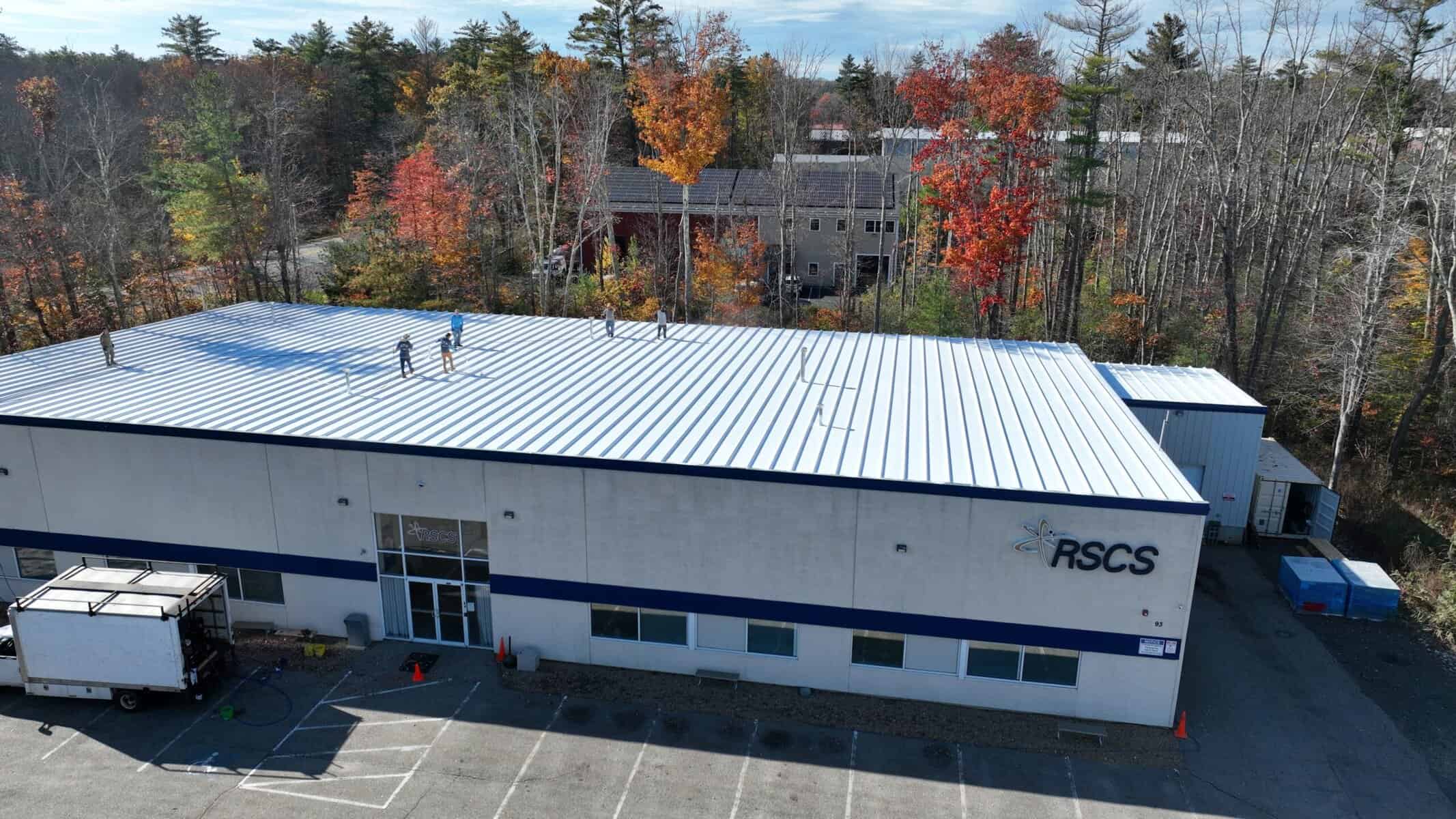
At Pease the access is the easy part. The hard part is that a single roof can be bigger than a downtown block, and the wind across the tradeport will take a sheet of membrane off a roof and across the parking lot if the crew lets it. We section the work so that every square foot we open gets closed and tied in the same day, and on a multi-tenant building we sequence the sections around who is below.
We own our telehandlers, coating sprayers and trucks, so a rental delay never pushes a job into the next week. On larger projects we bring in factory-trained subcontractor partners, and one of our own people runs the job. The owner deals with us, start to finish.
What maintenance keeps a flat roof out of trouble?
A flat roof does not fail all at once. It tells you first. A drain strainer full of leaves, gull shells and a tenant’s old filter box. A pitch pocket around a gas line with the sealant cracked open. A seam lifting an inch at the corner where the wind works it. A puddle that is still there on Thursday after rain on Monday. None of those is an emergency on the day you find it. All of them are an emergency by the time water shows up in the ceiling below.
A maintenance walk also catches damage from everyone else who goes up there: HVAC technicians dropping tools and panels, dragging units across the membrane and leaving screws behind, sign and satellite crews putting fasteners through the roof. A walk after any trade has been up is worth the half hour.
We offer seasonal inspection plans for owners who would rather have the roof looked at on a schedule than wait for a tenant’s phone call, and we document every walk with photos. On a coated roof, that walk is also what keeps the warranty in good standing.
Who installs commercial flat roofing in Portsmouth, NH?
Flat and low-slope roofs are a core part of our commercial roofing work across New Hampshire and southern Maine. We have been on roofs across Portsmouth for more than twenty-five years, from the waterfront to the tradeport, and the same crews that handle roofing in Portsmouth for homeowners handle the commercial side.
Two times we will send you elsewhere. If your roof was installed in the last few years by another contractor under a manufacturer’s warranty, call them first, because a repair by anyone else can void that warranty and you should not pay us for work someone else owes you. And if what you have is an old built-up tar and gravel roof with a decade of patches on it, be ready for us to tell you it is done rather than sell you one more patch. Otherwise, schedule a free commercial roof estimate. We will walk the roof, check it for moisture, and give you a written scope and a straight answer on repair, coating or replacement.
Frequently asked questions
Can a flat roof be coated instead of replaced?
Only if the insulation under it is dry and the membrane is intact. A core cut or moisture scan answers that in an hour. On a dry roof the GAF HydroStop system seals the seams and flashings and adds years with no tear-off. On a wet roof a coating traps the water and the owner pays twice. We will not coat a roof we have not checked.
How long does a commercial roof replacement take in Portsmouth?
A small downtown roof is usually a matter of days. A large building at Pease is measured in weeks. Either way we work in sections and close every section the same day it is opened, so the building is never exposed overnight, and we schedule the loud tear-off work around the hours the business and its neighbors are busiest.
Is standing water on a flat roof normal?
Water that drains within about two days after rain is normal. Water still standing after that is ponding, and it adds weight, ages the membrane and freezes into ice in winter. Most of the time the fix is a clogged drain or a low spot that needs tapered insulation, not a new roof, but it should be looked at before the next winter.
Can you install a new membrane over the old roof?
Over one existing roof, yes, if the insulation under it is dry, the deck is sound and the code allows it for that building. Never over two existing roofs, and never over wet insulation. The moisture check comes first, and if the roof fails it the old roof comes off so we can see and fix the deck.
Does the Historic District Commission review flat roof work downtown?
Usually not, because most flat roof work cannot be seen from the street. It can come up when the change is visible from the public way, such as taller rooftop equipment or a different edge metal on a downtown building. We will tell you before the job starts if your project needs a review, and we will plan the schedule around it.