How J. Carnes & Son Roofing finds and repairs wind damage on Hampton, NH roofs, from Hampton Beach and Great Boars Head to the village, and when a repair is not the right call.
Continue reading

How J. Carnes & Son Roofing finds and repairs wind damage on Hampton, NH roofs, from Hampton Beach and Great Boars Head to the village, and when a repair is not the right call.
Continue reading
Older Dover homes were built without soffit or ridge vents. Here is how we add balanced attic ventilation without touching the original trim.
Continue reading
The calls come in a pattern we know by heart. A nor’easter runs up the coast overnight, the wind swings to the northeast around two in the morning, and by six the phone starts. Water spotting a bedroom ceiling. A ridge vent peeled back. Half a dozen shingles in the yard and nobody sure whether what is left up there is still holding.
Most storm damage looks worse from the driveway than it is, and a little of it is worse than it looks. That matters, because the first few hours decide whether you end up with a roof repair or a roof, ceiling, insulation, and drywall repair. Here is what we do when that call comes in, and what you should be doing before we get there.
Emergency work is not something we bolt on after a storm. It is the same crews who install roofs here every week. A roofer who already knows your town knows which stretches of shore take the wind first and what was probably built under those shingles in 1978. That is the difference between a tarp thrown over a hole and a stabilization that actually stops water.
We cover Portsmouth, Rye, Hampton, North Hampton, New Castle, Stratham, Greenland and the towns around them, plus flat and membrane roofs through our commercial roofing side. If you are not sure you are inside our range, call and ask.
That last part is the one people ignore. A wet asphalt roof is slick, one with granule loss is slicker, and a gusting northeast wind will take you off a ladder without warning. Whatever is happening up there is already happening, and two more hours will not change it.
The controlled-drain trick surprises people. Water that gets past the roof runs along the top of the ceiling drywall until it finds a low spot and pools, and the drywall sags into a bubble. Left alone, that bubble lets go all at once and takes a section of ceiling with it. One small hole at the bottom of the sag turns a ceiling replacement into a patch and a coat of paint.
Photograph the ceiling, the attic if you can reach it safely, and the yard where shingles landed. Do it before the tarp goes on, because once a tarp is down the adjuster is looking at a covered roof and taking your word for what is under it.
We run tarp over the ridge whenever the damage sits near the top of a slope, for a simple reason. Water finds the top edge. A tarp that stops partway up a slope leaves a seam facing uphill, and the next rain runs straight under it. Carrying the material over the ridge and down the far side takes that seam out of the equation. Where the roof is too big or too cut up for that, the top edge gets tucked under the course above and battened down so it cannot lift.
Fastening is the other thing that separates a working tarp from a noisy one. Tarps fail in wind because somebody nailed through the grommets, and grommets tear. We sandwich the material under furring strips and fasten through the strips so the load spreads across the wood. That does put fasteners into your roof, in the area already being replaced, and we note where they went.
We would rather take the call and tell you it can wait than have you decide that yourself and get it wrong. Water coming in is always urgent, because the bill climbs by the hour once insulation is soaked. Exposed decking is urgent because the next rain does not need to be dramatic to do harm. A lifted edge is urgent because edges are where wind gets its grip. A limb on the roof is urgent whether or not you can see damage, because the weight is doing something you cannot judge from the ground.
Missing shingles on a dry roof, a bent gutter, or a vent cap in the yard are all worth getting on the calendar quickly. They are not worth a two in the morning response, and a roofer who insists otherwise is selling urgency.
Drive twenty miles west and the same roof ages differently. Out there the shingles give up first, sun-baked and curling in the field. Here they often still look serviceable while the nails holding them have rusted thin, the drip edge has gone chalky, and the step flashing at a chimney flexes when you press it. The roof passes a casual look and fails a storm.
So on a storm call we pull an edge and look underneath instead of counting missing shingles from the lawn. A roof that lost six shingles at the rake in a forty mile per hour gust is telling you something about the several hundred still up there. We went deeper on that in our post on wind damage on coastal homes, and it is why our Seacoast roof inspections spend most of their time at the perimeter. Gutters take the same beating and get overlooked because they are not leaking indoors, so if yours moved, say so when you call and we will look at the gutters and leaf guards while we are there.
We will tell you which it is even when the repair is the smaller job. A patched slope on a roof with four good years left is a fine outcome. A patched slope on a roof that has been failing since 2009 buys one winter, and you should hear that from us in September rather than find out in February.
If it does turn into a replacement, the process is the one we walk every homeowner through in our guide to planning a roof replacement, and everything we install is laid out on our roofing services page. On cost, we do not quote roofs over the phone and we do not publish numbers, because a number without a look at your roof is a guess dressed up as information. Estimates are free, and if the timing is hard we have financing options.
After a real storm the Seacoast fills with out of state plates, and some of those crews are perfectly competent. The problem is not skill, it is the warranty. Workmanship coverage is worth exactly the odds of somebody answering the phone in eight years, and a company chasing weather from state to state is not built to take that call. As for the deductible offer, anyone proposing to make it disappear is proposing to misrepresent the job to your insurer, and your name is the one on the claim.
You have time to check. A properly installed tarp buys days to make a good decision instead of minutes to make a fast one, and that is the point of the emergency call. If water is coming in, or something on your roof is not where it was last night, call us. We will tell you honestly whether it needs a truck tonight or a slot next week, and get the house dry either way.
Yes. Storm calls come in at every hour and we take them at every hour. What you get overnight is a real conversation with somebody who roofs here, not a voicemail box. Depending on what you describe and what the weather is doing, that call ends with a truck heading out or with a plan to get you through safely until morning.
Most homeowner policies cover reasonable emergency measures taken to prevent further damage, and emergency tarping is the textbook example. Policies differ, so confirm with your carrier, and keep your photos and our documentation. We put in writing what we found and what we did, which is the paperwork adjusters actually want.
It depends on the size of the damage against your deductible, and it is your call rather than ours. What we can do is document what happened thoroughly enough that you decide with real information. For small, isolated damage on an otherwise healthy roof, plenty of homeowners choose to handle the repair directly instead of opening a claim.
Same day in most cases, and often within hours. The exception is a storm still in progress, because nobody should be on a roof in high wind, including us. When that happens we say so plainly, help you control water from the inside over the phone, and come out the moment it is safe to work.
Yes, though the method is different. Flat and low slope roofs get a membrane patch or a temporary seal over the breach rather than a tarp run over a ridge, because there is no ridge to run over and standing water behaves differently than runoff. We handle emergency work on EPDM, TPO, and modified bitumen roofs on Seacoast commercial buildings.
Who are the GAF Master Elite certified roofing contractors in New Hampshire? There are fewer of us than most homeowners assume. GAF says only about 2 percent of roofing contractors in North America hold Master Elite status, and in a state the size of New Hampshire that works out to a short list. J. Carnes & Son Roofing is on it. We hold GAF Master Elite certification and the GAF President’s Club Award, and we install from Hampton Falls and Salem across the Seacoast, the Lakes Region and into southern Maine.
This post explains what those two credentials actually require, why they matter when you are comparing estimates at the kitchen table, which warranties only a Master Elite contractor can put on your roof, and how to check for yourself whether a roofer who claims the badge really has it. We have been asked all of this on driveways for years. Here it is written down.
GAF is the largest roofing manufacturer in North America, and it certifies contractors in tiers. At the bottom is a basic contractor listing, which means little more than that the company buys GAF product. Master Elite is the top of that ladder. It is the tier GAF points homeowners toward when they want a roof installed to the manufacturer’s own specifications, and it is the only tier that unlocks GAF’s best warranties.
The reason it is rare is not that the requirements are exotic. It is that they have to be met all at once and kept up every year. Plenty of good roofers never bother, and plenty of not-so-good ones cannot get past the insurance and licensing checks. On the Seacoast, where the ocean and the winter both work on a roof harder than they do inland, we think the training piece matters more than people give it credit for.
Here is what that looks like in practice, because the four bullet points on GAF’s site undersell it.
None of this is a guarantee that a Master Elite crew never makes a mistake. It is a guarantee that the company has been vetted by the manufacturer whose product is going on your house, and that the manufacturer will stand behind the installation in a way it will not for an uncertified roofer.
If Master Elite is the certification, President’s Club is the report card. GAF’s own wording is that it entrusts a select few Master Elite contractors with President’s Club status. The award recognizes contractors who are not just certified but are consistently installing complete GAF roofing systems, the kind that qualify for the Golden Pledge warranty, and doing it well enough and often enough that GAF notices.
For a homeowner, the practical meaning is simple. A President’s Club contractor has been installing full systems to the manufacturer’s spec at volume, and GAF has been checking. It is the difference between a company that qualified once and a company that keeps qualifying.
We are proud of the award, but we would rather you understand what it stands for than just see the logo. The logo is on our asphalt shingle roofing page alongside the Golden Pledge details, and on our listing in GAF’s contractor directory, which is where you should go to check it.
This is the part that changes your decision, so it is worth slowing down on.
Every GAF shingle comes with a manufacturer’s warranty on the material itself. That is true whether a Master Elite crew installs it or the neighbor’s cousin does. What changes with certification is the warranty on the whole system and on the workmanship.
| Warranty tier | Who can offer it | What it covers |
|---|---|---|
| Standard shingle warranty | Any installer | Manufacturing defects in the shingles |
| System Plus | GAF certified contractors and above | The GAF roofing system as a whole, with extended material coverage |
| Golden Pledge | Master Elite contractors only | Materials and workmanship, backed by GAF, with a GAF inspection of the installation |
Two things about the Golden Pledge that homeowners find surprising. First, GAF inspects the finished roof before the warranty is issued. A manufacturer’s representative actually looks at the installation. Second, the workmanship coverage is carried by GAF, not by us. If we were to close our doors tomorrow, the workmanship warranty would still be there. A roofer’s own workmanship warranty, however generous it sounds, is only as durable as the roofer.
We install the full GAF system on most of the residential roofs we do, which is what makes the Golden Pledge available. If you want it, say so at the estimate. It is a line item, and it is a decision, not something that appears automatically.
We have been a GAF contractor for a long time, and we have held Master Elite through the years when it would have been easier to let it lapse. The training requirement in particular is a real commitment for a crew that would rather be on a roof than in a classroom. We keep it up because the roofs we put on in Rye, Hampton and New Castle take more weather in a decade than most roofs take in their whole life, and the manufacturer’s spec exists for a reason.
What Master Elite does not mean is that we only install GAF. We do a great deal of standing seam metal roofing on the coast, and metal is the right answer for some houses. We also do commercial membrane work. The certification covers our asphalt shingle installations, which are the majority of residential roofs on the Seacoast and the ones the Golden Pledge applies to.
We bring this up because the badge gets borrowed. We have seen the Master Elite logo on the websites of companies that are not on GAF’s list, and on trucks belonging to crews that were certified years ago and are not anymore. The status expires if the requirements stop being met, and the logo does not remove itself from a van door.
So check. It takes about a minute. GAF’s directory is the only source that counts, and every legitimate Master Elite contractor will be happy you looked. Ours is linked above. While you are there, read the reviews on the GAF listing too. They are collected by GAF, not by the contractor, which makes them harder to curate.
One more thing to ask: whether the certification is held by the company giving you the estimate, or by a manufacturer’s program the company is loosely affiliated with. Master Elite is company-specific. It does not transfer through a franchise, a buying group or a friend.
We hear this worry a lot, and it is reasonable. The honest answer is that a well-run roofing company charges what the roof costs to do properly, and the things that make a roof expensive are the things that are true of the roof, not of the logo on the truck. We wrote a full guide on what determines roof cost in New Hampshire that walks through each of those factors, and none of them is certification.
Where a Master Elite estimate can differ is in what it includes by default. A crew trained on the full GAF system tends to price the full system: ice and water shield run well past code minimum, proper ridge and intake ventilation, new flashing rather than reused, and the starter and hip and ridge products that are part of the spec. A low estimate from an uncertified roofer often gets there by leaving those out. That is not a cheaper roof. It is a different roof.
If the timing is the issue rather than the number, we offer financing options on residential work.
Master Elite status follows the company, not a single address, so it applies to every roof we install. Our service area runs the length of the Seacoast from Seabrook to Portsmouth and Rye, west through Exeter and out to the Salem and Windham area, north to Dover and Rochester, and into southern Maine from Kittery to the Portland area. The full list is on our service areas page.
The coastal towns are where the certification earns its keep. Salt air, nor’easters, ice dams and freeze-thaw cycles are hard on a roof, and a system installed to the manufacturer’s specification holds up to them in a way a shortcut installation does not. Our guide to roof replacement in Portsmouth goes into what that looks like on a harbor-side house.
If you want a GAF Master Elite contractor to look at your roof, book a free estimate and we will walk it, measure it, and put the options in writing, including the Golden Pledge if you want it. See everything we do on our roofing services page.
No. GAF Certified is an entry-level designation. Master Elite is the top tier and has stricter requirements for licensing, insurance, reputation and training. Only Master Elite contractors can offer the Golden Pledge warranty. GAF says about 2 percent of roofing contractors hold Master Elite status.
Yes, GAF shingles are sold through normal supply channels and any roofer can buy and install them. The shingles carry their standard material warranty regardless of who installs them. What an uncertified roofer cannot do is offer GAF’s system and workmanship warranties, which require a certified or Master Elite contractor.
The Golden Pledge is GAF’s strongest warranty. It covers both the roofing materials and the workmanship of the installation, it is backed by GAF rather than by the contractor, and it includes a GAF inspection of the finished roof before the warranty is issued. It is available only through Master Elite contractors and must be requested at the time of the estimate.
No. The basic shingle warranty applies to any installation. You need a GAF certified contractor for the System Plus warranty and a Master Elite contractor for the Golden Pledge. If a warranty on the workmanship matters to you, and on a coastal roof it should, Master Elite is the tier that provides it.
Search the company on GAF’s contractor directory at gaf.com. A genuine Master Elite contractor is labeled on their listing, along with any President’s Club award. The listing also shows reviews that GAF collects directly. If the company is not in the directory, or is listed without the Master Elite designation, it does not currently hold the certification.
Most homeowners only replace a roof once or twice in their lives, so it makes sense that the process feels like a black box. You know a crew shows up, there is a lot of banging for a day or two, and then the house has a new roof. What actually happens in between, and what you should do before that first ladder goes up, is the part nobody explains until the truck is already in the driveway.
We replace roofs all over Portsmouth and the surrounding Seacoast towns, from capes near the traffic circle to colonials in the South End with three layers of history on the deck. This is the walkthrough we give homeowners at the kitchen table: how to tell replacement is really the right call, what the job looks like hour by hour, how long it takes, and how to get your house ready so the day goes smoothly.
Portsmouth has no shortage of trucks with ladder racks, and after a big wind event half of them seem to have Massachusetts plates. The advice we give people, even when they do not hire us, is to pick a roofer who was working here before the storm and will still be here after. A roof carries a workmanship warranty, and a warranty is only as good as the company’s odds of answering the phone in ten years.
We have built our name on the Seacoast doing this one trade. If you want to see how we think about the whole roof system, our roofing services page covers everything we install, from asphalt and metal to the flat rubber roofs on commercial buildings around town.
The honest test is whether the roof is failing in one spot or failing everywhere. Wind peels a dozen shingles off the windward slope, the rest of the roof is solid, and the shingles are young enough to match: that is a repair, and anyone who tells you otherwise is selling you a roof you do not need yet.
The pattern that points to replacement looks different. Granules collecting in the gutters every time it rains. Shingle corners curling up along the south-facing slopes where the sun does its work. A leak that comes back in a new spot every time it gets fixed. At that point you are not buying repairs, you are renting time, and each storm collects the rent.
Age matters more here than the shingle wrapper suggests. Salt air is mildly corrosive to everything it touches, and the wind that comes up the Piscataqua works shingle edges loose year after year. An architectural shingle roof that might cruise to thirty inland often starts showing real fatigue in its low twenties near the water. We wrote about what that exposure does to oceanfront homes in our Rye roof replacement guide, and Portsmouth gets a slightly gentler version of the same weather.
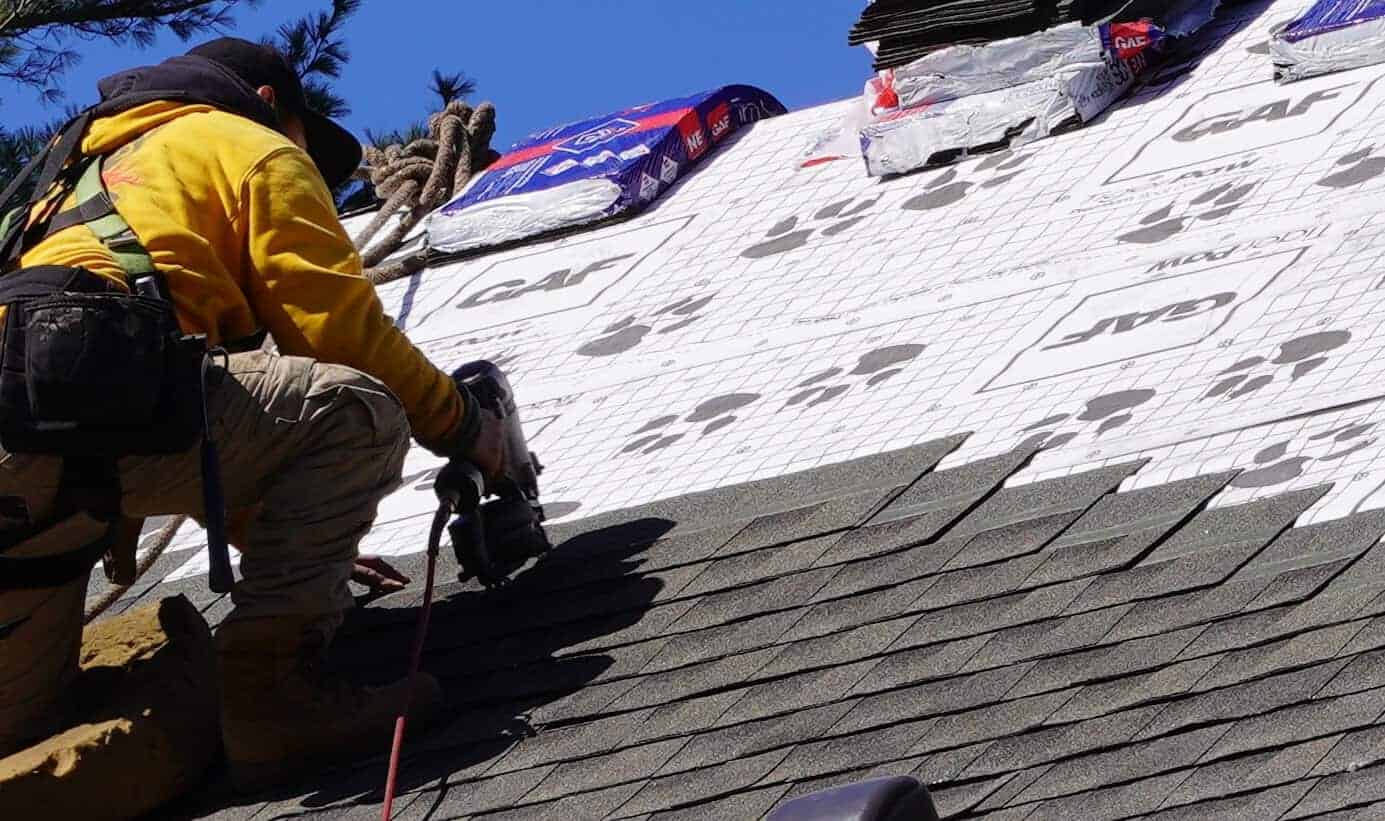
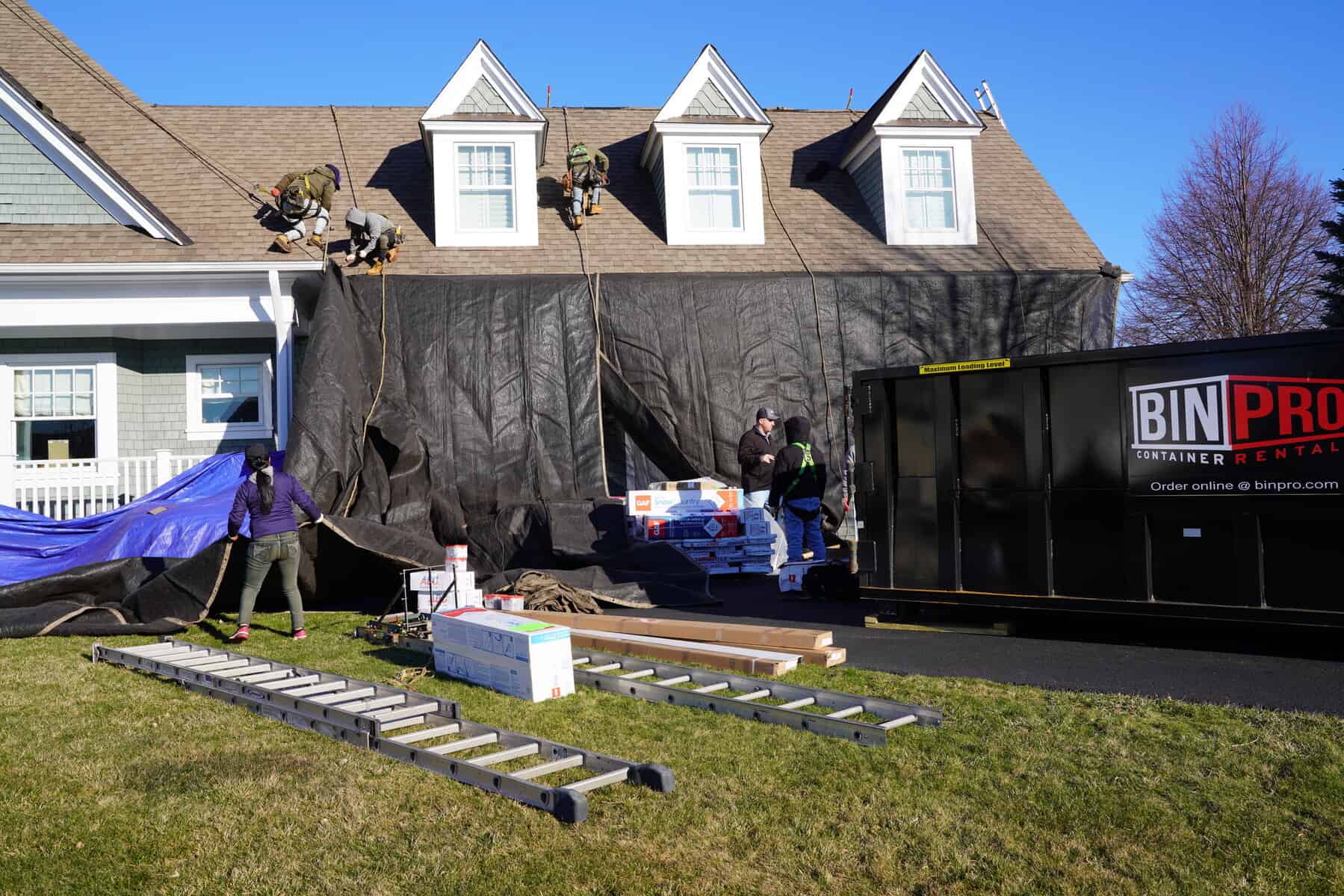
The first hour is all protection. Tarps go down over the landscaping and up against the siding, plywood shields anything delicate, and the dumpster gets positioned so shingles can come straight off the roof and into the container. It looks like a lot of ceremony until you remember that several tons of old roofing are about to slide down the slopes.
Then the tear-off. This is the loud part, and it is also the most important part of the whole job. Stripping to bare wood is the only way to actually see the deck, and the deck is where roofs hide their secrets. Soft plywood around an old chimney. A board deck from the 1940s with a couple of rotted planks under the valley that has been leaking, slowly and invisibly, for years. On older Portsmouth homes we expect to replace at least a few boards, and we photograph anything we find so you can see exactly what you are paying to fix before we fix it.
The rebuild goes fast once the deck is sound. Ice and water shield gets rolled along the eaves and up every valley, which is the layer that stops ice dam backup from getting into the house in February. Synthetic underlayment covers the rest. New drip edge goes on the perimeter, then shingles, then flashing around chimneys and walls, then ridge vent along the peak so the attic can breathe. Ventilation is the step bargain crews skip, and it is half the reason their roofs die young.
Cleanup is the part homeowners remember. Tarps come up, the yard gets walked, and magnetic sweepers roll over the lawn and driveway until they stop finding nails. A crew that leaves nails in a driveway where kids ride bikes did not finish the job, whatever the roof looks like.
The realistic answer for most houses is one full day of work, sometimes spilling into a second morning. What stretches a job is complexity, not square footage. A plain ranch with two big rectangular slopes goes fast. A colonial with dormers, a couple of valleys, and a chimney through the middle of a slope is slower, because every one of those features is hand work and flashing detail.
Two things add time that nobody can see from the street. Multiple layers, because some older homes have a second roof hiding under the first and both have to come off. And deck repair, which we never know the full extent of until tear-off. When we find something, we show you, we fix it, and the schedule moves a few hours. That beats the alternative of shingling over bad wood and letting you find it through the ceiling in a few winters.
Your list is short but it matters. The dumpster and the shingle delivery both want driveway access, so cars need to be out before we arrive, including anything in the garage you might want during the day, because the driveway will be blocked. Tear-off shakes the frame of the house more than people expect. Pictures on upstairs walls, china cabinets against exterior walls, and anything perched on a shelf under the roofline deserves a safer spot for a day.
If your attic is open storage, throw an old sheet over the boxes. Some grit and dust always sifts through the deck boards during tear-off, especially on older homes with plank decks and gaps. Dogs generally hate roofing day, and a day at a friend’s house is kinder than a day of percussion overhead.
On our side, planning means the permit, the material order, and an eye on the forecast. Portsmouth wants a permit pulled for a full replacement and we take care of that paperwork. As for money conversations, we do them the straightforward way: a free estimate in writing after we have actually looked at your roof, and financing options for the projects that were not in this year’s budget. A roof rarely fails on a convenient schedule, and we quote every job so you know where you stand before anyone touches a shingle.
Distance to salt water is the quiet variable in every Seacoast roofing decision. Salt spray rides the wind further inland than most people think, and it goes to work on exposed metal first: cheap flashing, bargain fasteners, unpainted steel. That is why we spec corrosion-resistant details on coastal work as a matter of habit, and why a growing number of Portsmouth homeowners skip the debate entirely and go metal. If that route interests you, our guide to metal roofing in Portsmouth covers how standing seam handles salt air.
The housing stock is the other difference. A lot of Portsmouth was framed generations before plywood existed, so we plan on plank decks, real dimensional lumber, and the occasional surprise where three renovations meet. Downtown, homes inside the historic district can need a review before changing what the roof looks like from the street, which is worth knowing before you fall in love with a color. None of this is a problem. It is just the difference between a crew that works these streets every week and one that quotes every house like it was built in 1995.
If your roof is coming due, start with a conversation instead of a guess. Request a free estimate and we will look at the roof, show you photos of what we find, and give you a straight answer on whether this is a repair year or a replacement year.
Architectural asphalt shingle roofs near the coast typically deliver twenty to twenty-five solid years, a bit less with direct ocean exposure and a bit more with good ventilation and some shelter from the wind. Standing seam metal roofs run far longer, often fifty years and up. The roof tells you when it is ready: granule loss, curling, and repeat leaks are the signals that matter more than the calendar.
Yes. We roof year-round on the Seacoast. Cold-weather installs take extra care because shingle adhesive strips need warmth to seal, so shingles get hand-sealed where conditions call for it, and we watch the forecast so the deck is never open ahead of weather. A failing roof in January should not wait for April.
A full roof replacement in Portsmouth needs a building permit, and homes in the downtown historic district can also need a review if the roof’s appearance changes. We handle the permit paperwork as part of every replacement, so for the homeowner this is a line item to confirm your contractor covers, not a form to fill out yourself.
We photograph it, show you, and replace the bad wood before any new roofing goes on. Rot hides under old shingles, especially around chimneys, valleys, and eaves where ice dams have worked over the years, so on older homes a few replaced boards are normal. Shingling over soft wood is how a new roof fails early, and we will not do it.
You do not need to be. Most of our customers go to work and come home to a finished roof. Being reachable by phone is what matters, so we can show you anything the tear-off reveals and get a quick decision instead of stalling the crew. If you are home, plan around a loud day and a blocked driveway.
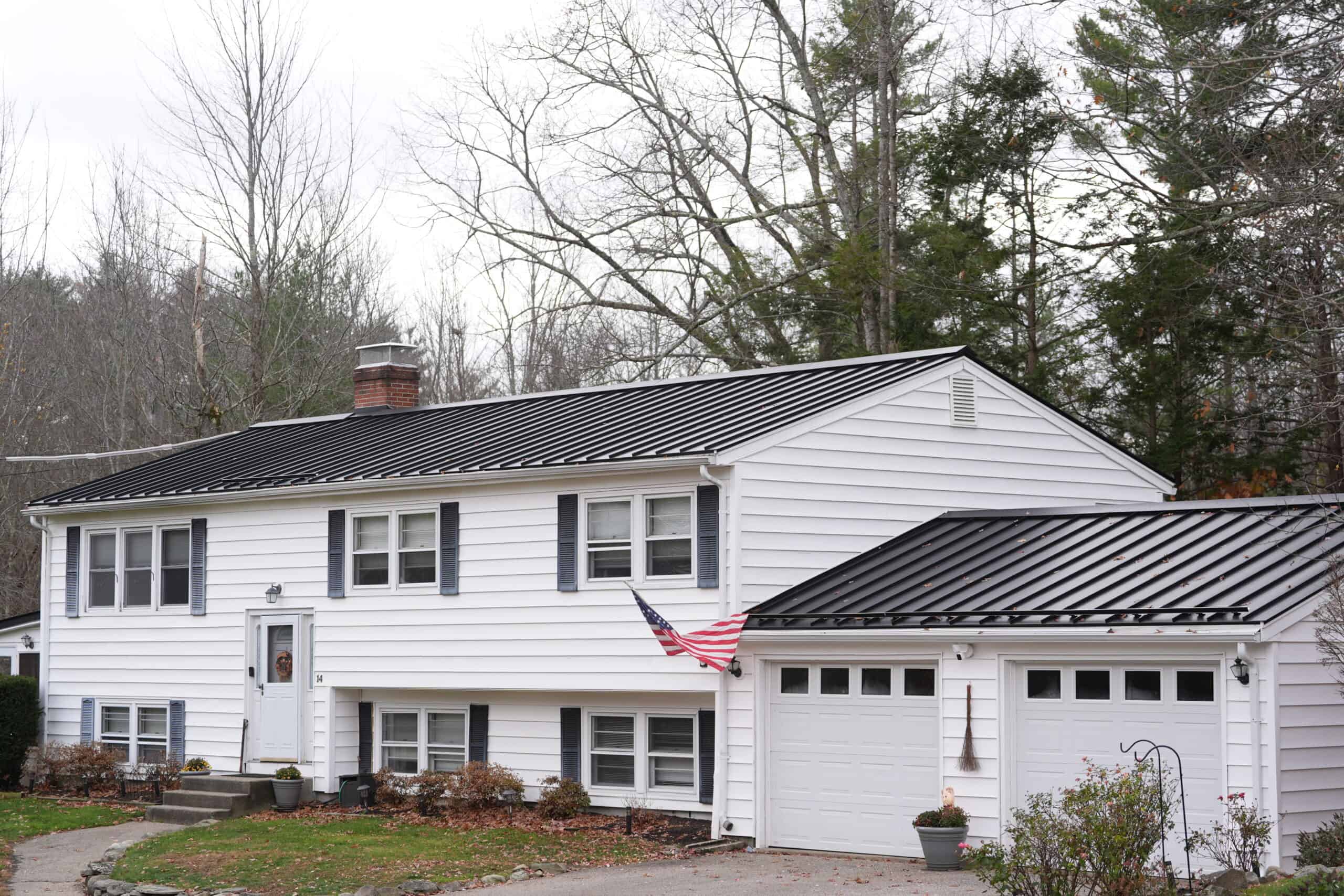
Drive any road within a few miles of the water here, from New Castle up through Rye and into Portsmouth, and count the metal roofs. Ten years ago you would have spotted a handful, mostly on barns and camps. Now they are on capes, colonials, and split-levels all over the Seacoast, and the number grows every season. That is not a style trend. Homeowners near the ocean are making a durability decision, and once you understand what salt air and coastal wind do to a roof, the logic is hard to argue with.
We install both asphalt shingle and standing seam metal roofing across New Hampshire and Southern Maine, so we have no horse in the race. Shingles are still the right call for plenty of houses. But when a homeowner a quarter mile from the water asks us what we would put on our own house in their spot, the answer is standing seam, and this post explains why. It also covers the honest downsides, because a roof you will live under for half a century deserves a straight sales pitch.
The word metal covers a lot of ground, and the cheap corrugated panels on an agricultural building have little in common with a residential standing seam system. On a screw-down roof, every one of those face screws carries a rubber washer that bakes, shrinks, and cracks over the years. Each failed washer is a leak waiting for a wind-driven rainstorm to find it. On the coast, salt accelerates the whole process, corroding the screw heads themselves.
Standing seam eliminates that entire category of failure. The panels attach with concealed clips that let each panel expand and contract as temperatures swing, which matters in a state that can see below-zero mornings in January and roof-surface temperatures well past a hundred degrees in July. The seams stand an inch or more above the drainage plane, so the water running down your roof never crosses a fastener or a joint at panel level.
Asphalt shingles are a fine product inland. Get within sight of the Atlantic and their weaknesses start stacking up. Shingle tabs are held down by adhesive strips, and repeated nor’easter gusts work them loose one storm at a time. We replace wind-stripped shingle sections in Rye and New Castle every spring, usually on roofs that are nowhere near the end of their rated life. The ocean does not care about the rating on the wrapper.
Salt air also ages shingles from the surface in. The granule layer that protects the asphalt underneath erodes faster in coastal exposure, and once granules go, the sun finishes the job. A shingle roof a block from the beach simply does not last as long as the same roof ten miles inland. We wrote about this in detail in our guide to metal roofing in Portsmouth, where the harbor-front housing stock takes some of the worst exposure in the state.
Then there is winter. A smooth metal surface sheds snow before it can sit, melt from house heat, and refreeze at the cold eaves as an ice dam. Ice dams are one of the most common causes of winter water damage we get called for on the Seacoast, and standing seam roofs mostly take that problem off the table. The snow ends up in the yard instead of backed up under your roofing.
People sometimes hear metal and ocean in the same sentence and picture rust streaks. That happens when the wrong product goes up. Plain galvanized steel close to the water will eventually show its edges, especially at cut ends and around penetrations. That is not a reason to avoid metal. It is a reason to pick the right metal.
Aluminum simply does not rust, which is why it is the default on oceanfront work. Modern coated steel panels with a PVDF finish, the marine-grade paint system most premium manufacturers use, hold up well even in heavy salt exposure, and manufacturers back the finish with long warranties. Where the experience shows is in the details: how cut edges are hemmed, how flashings are folded, what metals touch each other. Mixing incompatible metals, like letting copper runoff hit bare steel, sets up galvanic corrosion that no paint system can stop. A crew that details coastal roofs every week builds these habits in. A crew that mostly does inland shingle work may not know what the salt will find.
A nor’easter coming ashore at Hampton or Rye pushes sustained wind at roof planes for hours, not minutes. Shingles resist that with adhesive strips and nails near the tab edge. Standing seam resists it with mechanical interlocks running the full length of every panel and clips fastened straight into the deck. The failure modes are just different animals. After the big wind events, our repair calls are almost entirely shingle roofs. The standing seam roofs we have installed on the Seacoast have come through those same storms without a service call.
Snow behavior deserves a caution, though, because it cuts both ways. Snow leaving a metal roof leaves all at once, in a slide that can bury a walkway or flatten shrubs. Over doors, walkways, and anywhere people pass, we install snow retention, small rails or brackets that hold the blanket in place so it melts gradually. It is a standard detail on our New Hampshire installs, and it is the kind of thing that separates a coastal metal roof done right from a panel job.
Standing seam is a specialty trade inside a trade. The panels for a proper job are often roll-formed to length, the flashings are hand-folded, and the layout has to account for thermal movement that shingle roofs never deal with. Plenty of good shingle crews will take a metal job and learn on your house. That is the situation to avoid, and it is worth asking any bidder how many standing seam roofs they put on last year and where you can drive past one.
Our answer to that question is all over the Seacoast. We have put standing seam on harbor-exposed homes in Portsmouth, on capes and split-levels from Rye to Stratham, and on camps and farmhouses inland where owners just wanted their last roof. If you want to see what a black standing seam roof looks like on a classic white New England house, the photo on this post is our work, not a stock image.
We tell every homeowner the honest version. A standing seam roof costs meaningfully more up front than an architectural shingle roof on the same house. We do not publish numbers because every roof is different, and anyone who quotes you a price without measuring your roof is guessing. What we can say is that the math changes when you think in decades: one metal roof can outlast two or three shingle cycles, and financing lets you spread the investment rather than absorbing it at once. A free estimate gets you real numbers for your actual house.
Two smaller things belong in the honest column. First, oil canning: flat metal panels can show slight waviness in raking light. It is cosmetic, it does not affect performance, and good installers minimize it with panel striations and careful substrate prep, but you should know the term before you shop. Second, the noise myth can die here: over solid decking and underlayment, a standing seam roof in the rain is no louder than shingles. The tin-roof drumming people remember comes from open-framed barns, not houses.
If your shingle roof near the coast is on its second round of wind repairs, or you are planning the roof you never want to think about again, it is worth pricing both options side by side. Our roofing services team quotes shingle and standing seam on the same visit, so you can compare real numbers instead of averages off the internet.
Fifty years is a reasonable expectation for a properly installed standing seam roof here, and many go longer. The paint finish typically carries a manufacturer warranty measured in decades. Compare that with the real-world life of coastal shingle roofs, which salt and wind often retire early, and the lifetime math favors metal.
Sometimes, but on coastal homes we usually recommend a full tear-off. Stripping the old roof lets us inspect the decking, replace anything soft, and start with a flat, sound substrate, which also reduces oil canning. A roof intended to last fifty years should not be built on a questionable base.
Not on a house. Residential standing seam goes over solid decking and underlayment, which absorb the sound, so rainfall is about as loud as it is on an asphalt roof. The loud metal roofs people remember are uninsulated panels over open framing on barns and sheds.
Black and dark charcoal are the current favorites on the Seacoast, especially on white and gray houses, and the classic look holds up. Lighter colors reflect more summer heat. Every major panel line offers coastal-rated finishes across its color range, so pick for the house. Just confirm the finish grade, not just the color chip.
Very little, which is part of the appeal. An occasional rinse of accumulated salt film, keeping valleys and gutters clear, and a look at sealed penetrations every few years covers it. There are no granules to shed, no tabs to re-glue, and no exposed fasteners to re-gasket.
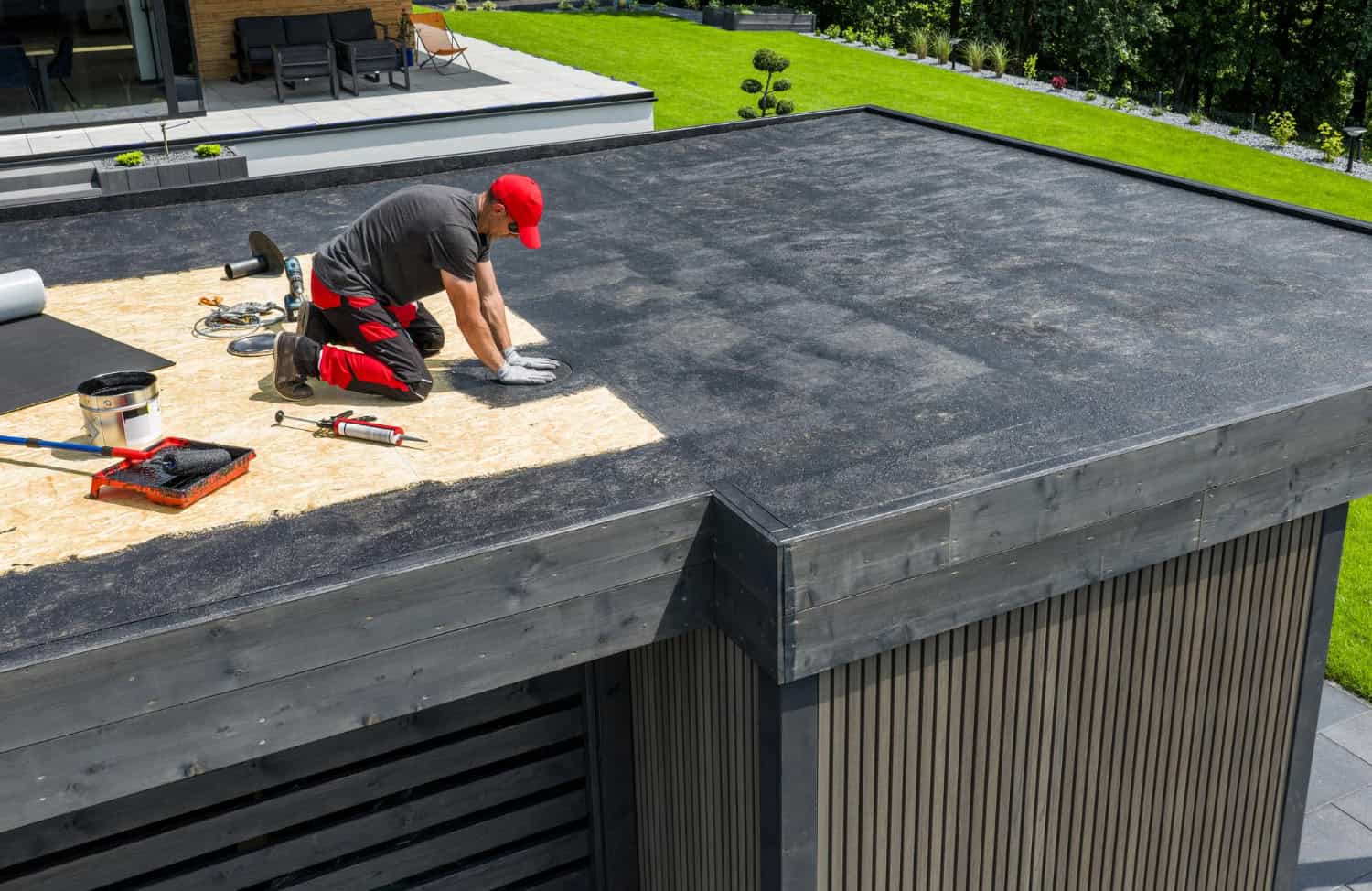
Flat roofs in New Hampshire see a lot of punishment in summer. Hot, bright days are followed by quick thunderstorms, coastal squalls, and the occasional hail burst. If you own or manage a commercial building or multifamily property, your flat roof is on the front line.
Flat roofs get hit harder because water tends to sit longer, drainage is slower, and the large open surface gives wind more to grab. UV rays also beat down on the membrane all day, then sudden cold rain shocks the material. Some of that damage you can prevent with good care and planning. Other problems need professional flat roof repair in New Hampshire before they spread into leaks and interior damage.
We’ve spent years on roofs across New Hampshire and Southern Maine, and every late summer we see the same patterns. The same weak spots fail, the same quick fixes peel up, and the same drainage issues show up when storm lines keep rolling through.
Summer storms here are short, sharp, and messy. A calm afternoon can flip to heavy rain and gusty wind in minutes. Your flat roof has to deal with:
Different roof systems handle that stress in different ways. On EPDM, TPO, and PVC membranes, we often see:
On modified bitumen or built-up roofs, storms can open blisters, crack older surfaces, and wash away loose protective layers. Along the Seacoast, wind-driven rain can push water sideways under loose metal edges and up against parapet walls. In wooded towns, branches and leaves clog drains, then back-to-back storms turn your roof into a shallow pool.
When we get called for flat roof repair in New Hampshire after a strong storm, we usually find the same problem areas. The roof rarely fails in the middle of a clean, open field of membrane. It fails at the details.
Drainage is a big one. Heavy rain finds every weakness in:
If water cannot leave the roof, it starts to find seams and cracks. Transitions are another weak spot. Areas around HVAC curbs, vents, skylights, parapet walls, and edge metal see a lot of movement and stress. Old sealant pulls away, flashing cracks, and water driven by wind slips underneath.
If you have older “band-aid” repairs, summer storms will test them. Dried-out caulking, peeling patches, and UV-brittle surfaces may look fine on a dry day, then fail fast when sun, heat, and pounding rain hit together. Features like poorly sealed skylights are also common leak sources, which is why many owners ask about better skylight solutions when they plan roof work.
You cannot control the weather, but you can control how ready your flat roof is when the big storms show up. A good plan starts in late spring or early summer, before storm frequency ramps up.
A professional inspection should include:
Building owners and facility teams still play an important role. Day-to-day tasks might include:
Preventative maintenance usually means fewer surprise leaks, less damage to ceilings and equipment, and a longer life for the entire roof system. It also reduces the need for sudden emergency flat roof repair in New Hampshire during the busiest part of storm season, especially when owners stay ahead of ponding water and drainage problems on commercial flat roofs.
Even a well-cared-for roof can be hit hard by a strong storm. Some signs tell you that you need urgent help:
Safety comes first. If you suspect damage:
When you see those issues, bring in a local flat roof specialist who understands New England weather and commercial systems. We assess the damage, provide temporary weatherproofing to get you through the next round of storms, and lay out a plan for permanent repairs that match your roof type and building use, which is exactly what you should expect from commercial roofing solutions built for flat and low-slope roofs.
If your flat roof struggles every storm season, it may be time to think about upgrades that make the whole system tougher. Storm-focused improvements often include:
Other protective changes can include higher wind-rated assemblies, cover boards under the membrane, tighter fastener patterns, walk pads around service areas, and reflective coatings that reduce UV and heat stress. Good gutter and leaf guard setups also help by keeping water moving, which is why many owners pair roof work with improved gutter and leaf guard systems.
In New Hampshire, any solution has to work year-round. That means handling snow and ice in winter, strong sun and sudden storms in summer, and coastal exposure in some towns. Matching the roof system, details, and maintenance plan to those conditions is the best way to keep your flat roof ready for whatever the next storm throws at it.
If you’re seeing storm-related issues on your flat roof, or you want to get ahead of peak storm season, call our team or request a free flat roof evaluation and quote. We’ll put our New England jobsite experience to work keeping your building dry and protected.
If your commercial or residential flat roof is showing signs of trouble, we are ready to help you protect your building before small issues turn into major repairs. Learn more about how our team at J. Carnes & Son Roofing handles flat roof repair in New Hampshire with careful inspections, clear recommendations, and quality workmanship. To discuss your project or schedule an appointment, call us or get a free quote.
Stratham sits just far enough from the water that people assume the coastal rules do not apply here. They do. The wind that comes up the Squamscott and across Great Bay does not check the town line, and the roofs we work on along Portsmouth Avenue and up around Stratham Hill take the same nor’easters as the ones in Rye, just with more trees involved. So when a Stratham homeowner starts collecting roofing quotes, they are shopping for the same thing an oceanfront homeowner is: a crew that understands Seacoast weather, not a crew that happens to own ladders.
Here is the uncomfortable truth about hiring a roofing contractor in Stratham: the state of New Hampshire will not vet them for you. Anyone with a pickup and a Facebook page can call themselves a roofer here, legally. That puts the vetting job on you, and most homeowners have no idea what to ask. We have been on the other side of this conversation for years, and we can tell you exactly which questions make a good contractor comfortable and a bad one squirm. Ask these before anyone sets a ladder against your house.
This surprises almost everyone we meet. Massachusetts has a state construction supervisor license. Maine at least requires specific things for some trades. New Hampshire takes a different view: no license, no state exam, no contractor board to complain to. The town of Stratham will handle your building permit, but the permit process checks the work, not the person doing it.
What that means in practice is that the phrase “licensed and insured” on a New Hampshire roofer’s yard sign is half marketing. There is no roofing license to hold. The insured half is the half you can verify, and it is the half that matters, because roofing is dangerous work and an uninsured injury on your property can land on your homeowner’s policy.
So skip the question “are you licensed” and replace it with three better ones: who is your insurance carrier, will your agent send me the certificate directly, and how long have you been working under this business name on the Seacoast. A contractor who has been putting roofs on homes from Rye to Exeter under the same name for decades has a reputation he cannot afford to burn on your job. That reputation is the real license.
General liability covers your house if the crew drops a bundle through your slider or a tarp fails in a downpour. Workers’ compensation covers the crew if someone gets hurt on your property. You want both, and the workers’ comp question is the one people skip. A crew of “independent contractors” with no comp coverage is cheap for a reason, and if one of them falls off your roof, the search for a responsible party can end at your address.
The direct-from-agent trick is the single most useful thing in this article. Every legitimate contractor’s agent sends certificates out all the time, for builders, for towns, for commercial property managers. It takes the agent five minutes. If a roofer hesitates at the request, you have learned what you needed to know for the price of one awkward phone call.
A one-page quote that says “strip and re-roof, 30-year shingles” tells you almost nothing. Which shingle line, because they perform differently in coastal wind. How far up the eaves does the ice and water shield run, because on a shaded Stratham lot with real snow load, the code minimum is a starting point, not an answer. Is the old flashing being reused or replaced, because reused step flashing against a chimney is where we get called to chase leaks two winters later.
Then there is the decking question, and on this one we will tell you exactly what to ask: what is the price per sheet of plywood if you find rot, and will you photograph anything you replace. Nobody can see through shingles. An honest contractor prices the unknown in the open before the job starts. A less honest one leaves it out, wins the bid on price, and finds a lot of rot once the roof is open and you have no leverage left.
Every legitimate roof replacement we do starts with this scope conversation, and the pattern holds across every quote you will collect: the contractors with the most detailed paperwork are almost never the ones you have problems with.
The roofing industry runs on subcontracted labor more than homeowners realize. The salesman with the nice truck and the crew tearing your roof off at 7 am may have never met. There is nothing inherently wrong with subs, but you should know what you are buying, because quality control lives with whoever is standing on the roof deck making the small decisions all day. Who is the lead on my job, and will the same crew be here start to finish, are fair questions with easy answers.
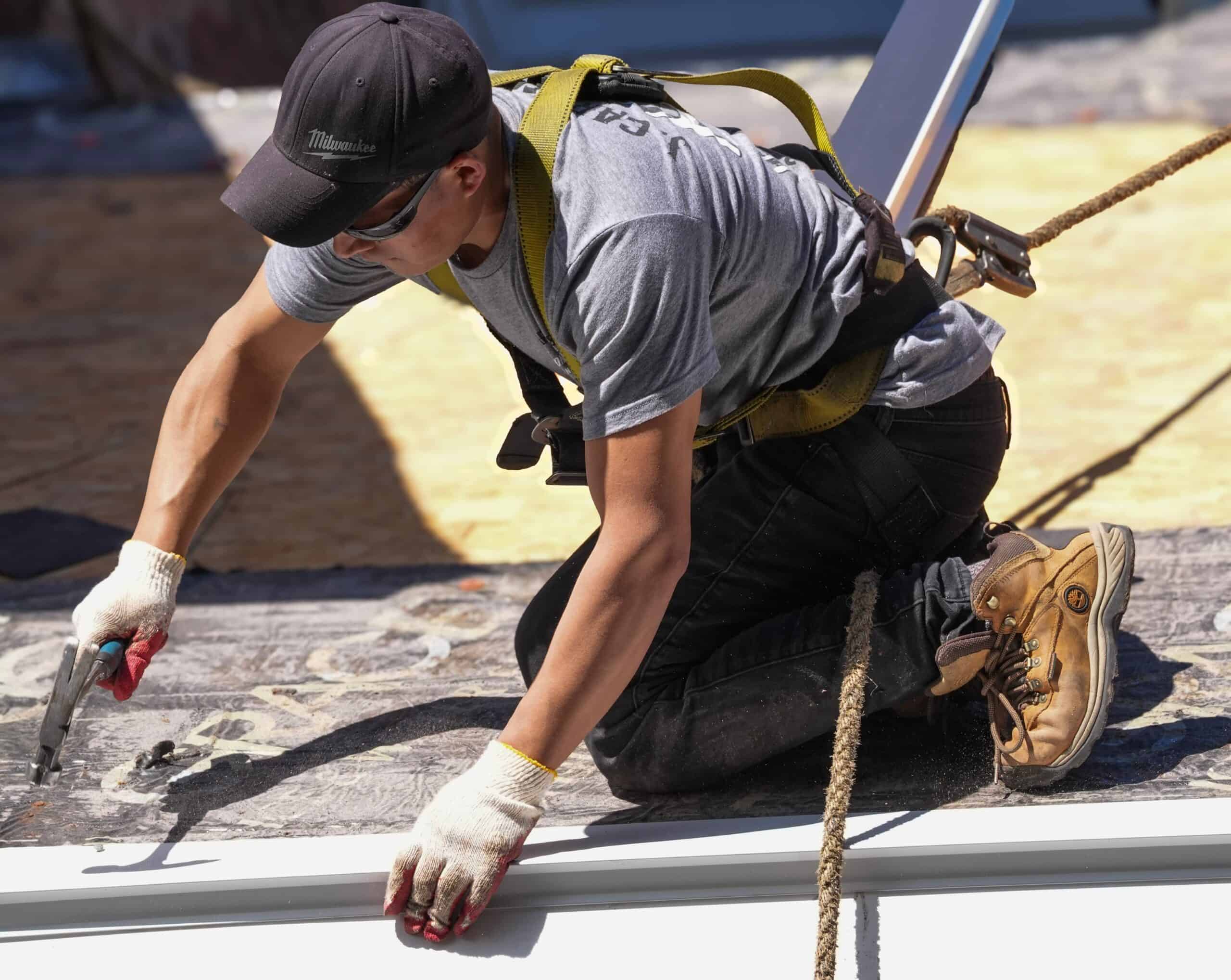
Safety tells you more than it seems to. A crew working in harnesses, tied off, with the site taped and the landscaping tarped, is a crew run by someone who sweats details. The same discipline that keeps a roofer clipped to an anchor is the discipline that gets six nails into every shingle in the wind zone instead of four. When we photograph our jobs, those harnesses are in the pictures because that is how the work actually gets done. If a crew is free-walking a two-story colonial roof, ask yourself what other corners look reasonable that day.
After every named storm that crosses the Seacoast, they arrive. Trucks you have never seen, canvassing neighborhoods off Winnicutt Road and Union Road, offering free inspections and same-week starts. Some are legitimate. Enough are not that the pattern is worth knowing.
The tells are consistent. Urgency is the big one: prices that expire today, claims that your roof is an emergency after a ten-minute look. The insurance angle is another. A contractor who promises to get your whole roof paid for by insurance before an adjuster has seen it is writing checks your policy may not cash. And the deposit structure tells its own story. A modest deposit to schedule the work is normal business. Most of the money up front, from a company with no address you can drive to, is how people end up with a stripped roof and a dead phone number.
The counter to all of it is boring: hire somebody local enough to be accountable. A shop that has been on the Seacoast for years will still be here when your neighbor asks who did your roof. That is the accountability no contract clause can replicate.
Shingle manufacturers advertise long warranties, and homeowners hear those numbers as “my roof is covered for decades.” Read the fine print and the coverage is against manufacturing defects, which cause a small fraction of real-world roof failures. The leaks we get called to fix almost always come from installation details: flashing, fastening, ventilation, sealant. That is workmanship territory, and workmanship is warranted by the contractor, not the manufacturer.
So ask the question directly: if this roof leaks in year three because of how it was installed, what happens? You want the answer in writing, with a number of years attached. Also worth knowing: many manufacturer warranty tiers require correct installation and registration to reach their full terms, which loops right back to the quality of the contractor you pick. The warranty conversation and the workmanship conversation are the same conversation.
The worst time to pick a contractor is with water coming through the ceiling, which is exactly when the least scrupulous operators do their best business. If your roof is past twenty years old, or the inspection habits we recommend for Seacoast homes have turned up granule loss or rusting fasteners, start the conversation while it is still a project instead of an emergency.
When the quotes come in, resist the urge to sort by price and pick the bottom. Line them up scope against scope. If one contractor is at a significantly lower number, the money came from somewhere: a lighter shingle line, reused flashing, no decking allowance, an uninsured crew. Sometimes the low bid is honest efficiency. Usually it is a difference you will find later, on your roof, in the rain. And if budget is the real constraint, say so out loud. There are legitimate ways to work with it, from material choices to financing, that beat quietly buying a thinner roof.
We are a family roofing company based in Hampton Falls, one town over, and we have been answering these exact questions for Stratham homeowners for years. If you are collecting quotes, we would like to be one of them. Reach out for a free estimate and put every question in this article to us. That is what they are for.
Two or three from contractors you have already screened for insurance and local track record. More than that and the scopes get hard to compare honestly. The screening matters more than the count: three quotes from vetted local companies beat six from whoever knocked on the door.
Re-roofing work in Stratham generally goes through the town’s building department, and pulling the permit should be the contractor’s job, not yours. Treat it as a screening question: a contractor who suggests skipping the permit to save time is telling you how they handle the parts of the job you cannot see.
Most single-family asphalt roofs on the Seacoast are done in one to three days once materials are on site, weather permitting. Complexity drives the range: steep pitches, multiple layers to strip, chimneys and valleys, and any decking replacement add time. Your quote should include an expected duration.
Roofing runs from spring through late fall here, and asphalt shingles seal best with some warmth in the air. Late summer and early fall are the sweet spot on the Seacoast. Winter work is possible when a failure forces it, but planned replacements are easier to schedule, and often smoother, in the warmer months.
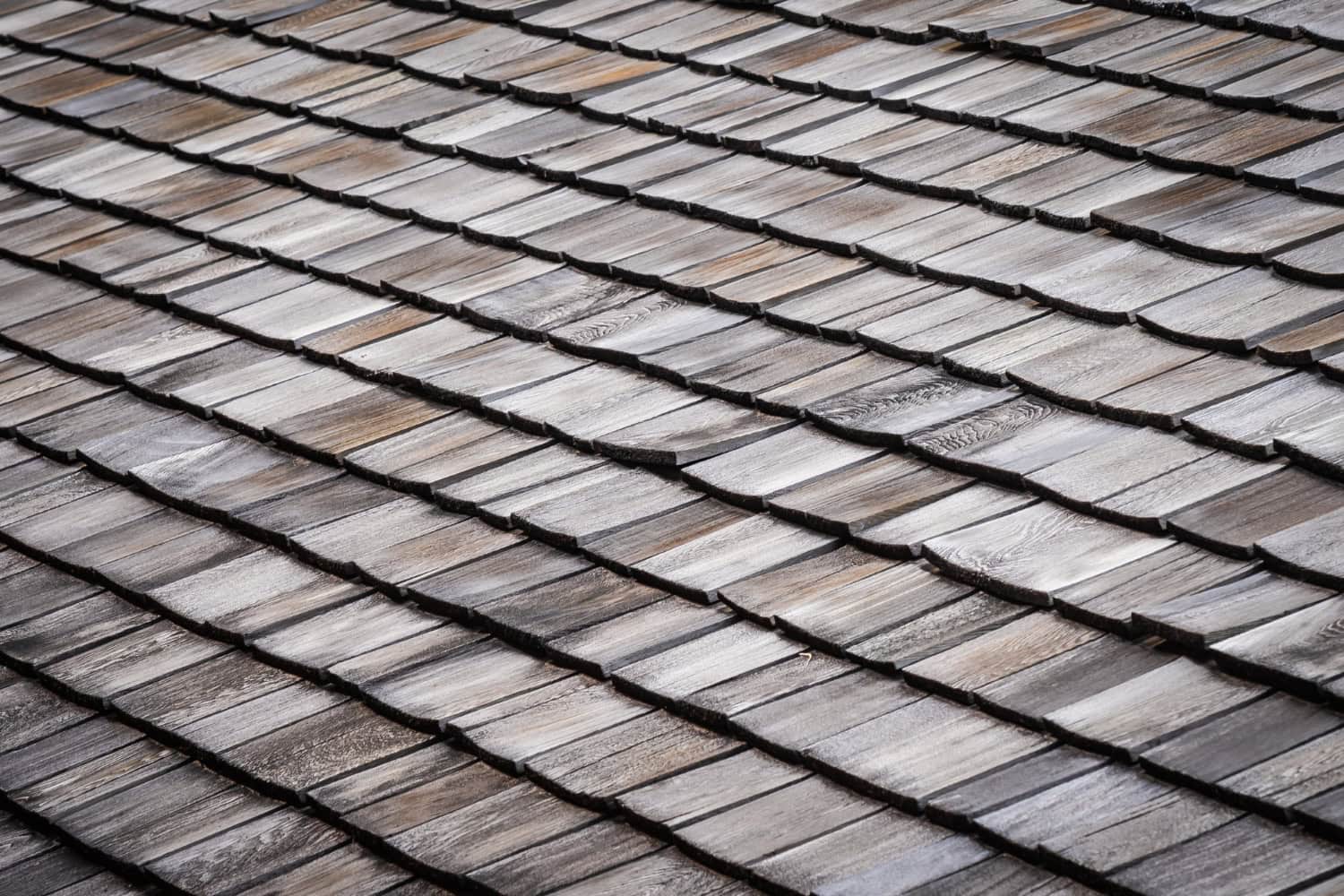
When you start seeing bare spots on shingles, granules in the gutters, or small leaks around vents, it is usually a sign your roof is ready for replacement. In New Hampshire, waiting too long can mean leaks turning into interior damage once the next round of storms rolls through. Planning your asphalt shingle roof replacement the right way helps protect your home and your peace of mind.
Good planning is not only about the shingle color. Here, weather can flip fast, lots of homes sit close together, and many towns have their own rules. Timing, permits, where the dumpster goes, and how the crew protects your yard all matter just as much as the roof system itself. As a local New England roofer, we have seen what works and what causes headaches, and we want to share a simple roadmap you can follow.
New Hampshire roofs see everything: heavy snow, ice, strong sun, wind, and big temperature swings. All of that affects how shingles seal, how underlayment performs, and how safely a crew can work on your home. The goal is to install your new asphalt shingles in a window that supports a clean, dry, steady job.
Here is how the main seasons usually shake out for asphalt shingle replacements:
A reputable roofer will:
If you want a late summer or fall install, it pays to get on the schedule early. That way you get the time window you prefer instead of taking whatever is left, and reviewing homeowner roofing resources for estimates, warranties, and planning can help you ask better questions before your project is booked.
Most towns in New Hampshire expect some kind of permit or at least notice when you replace a roof. Skipping this step can cause problems with insurance, slow things down if an inspector stops the job, or create headaches when you try to sell the home later and paperwork does not match what is on the roof.
The basic process usually looks like this:
Local codes often touch on things like:
We work with New Hampshire building departments on a regular basis and stay aware of common local rules. That helps keep projects smooth, safe, and code compliant, whether we are doing straight asphalt shingles or also working around features like new or existing skylights.
Dumpster placement might sound simple, but done wrong it can damage your property or slow the job down. Done right, it protects your driveway, keeps debris controlled, and helps the crew work faster with less mess.
Here are key things we look at before placing a dumpster or heavy truck:
A typical setup for an asphalt shingle roof replacement includes:
Homeowners can help by:
A little planning here goes a long way toward fewer stray nails, less cleanup, and less stress during the project.
New England yards often have mature trees tight to the house, raised beds, stonework, and composite decks that you want to keep looking great. Roofing involves tear-off, and that means debris, dust, and nails that can fall if the crew does not plan ahead.
Professional crews should have a clear protection plan that includes:
Before the job starts, walk the property and make a list of items to protect, such as:
Ask how these areas will be covered or shielded, and confirm there will be a final walkaround at the end so you can look over landscaping and outdoor spaces together. That shared check helps catch anything that needs attention before the crew packs up.
Knowing the general flow of the project makes the whole experience less stressful. While every home is a little different, a typical asphalt shingle replacement follows this pattern:
You can expect noise, vibrations, and limited access to some doors or parts of the driveway while work is underway. To get ready, many homeowners:
Good communication with your project manager keeps everything on track. Daily check-ins help you understand what was done that day, what comes next, and how any weather changes are being handled. The goal is to keep your home watertight at every stage, even if a sudden storm moves through while work is in progress.
Planning ahead on season, permits, dumpster logistics, and yard protection sets you up for a smoother asphalt shingle roof replacement and a stronger, better-looking roof over your home. Thoughtful details outside the shingle choice are what make the project feel organized instead of stressful, from the first shingle removed to the last nail picked up.
If your roof is aging, leaking, or showing obvious wear, now is the time to schedule professional asphalt shingle roof replacement with J. Carnes & Son Roofing. We will inspect your roof, explain your options clearly, and provide a detailed, no-pressure estimate so you can make a confident decision. Our team focuses on long-lasting workmanship and clean, respectful service at your home. Have questions or ready to schedule an appointment? Get a Free Quote or call us today.
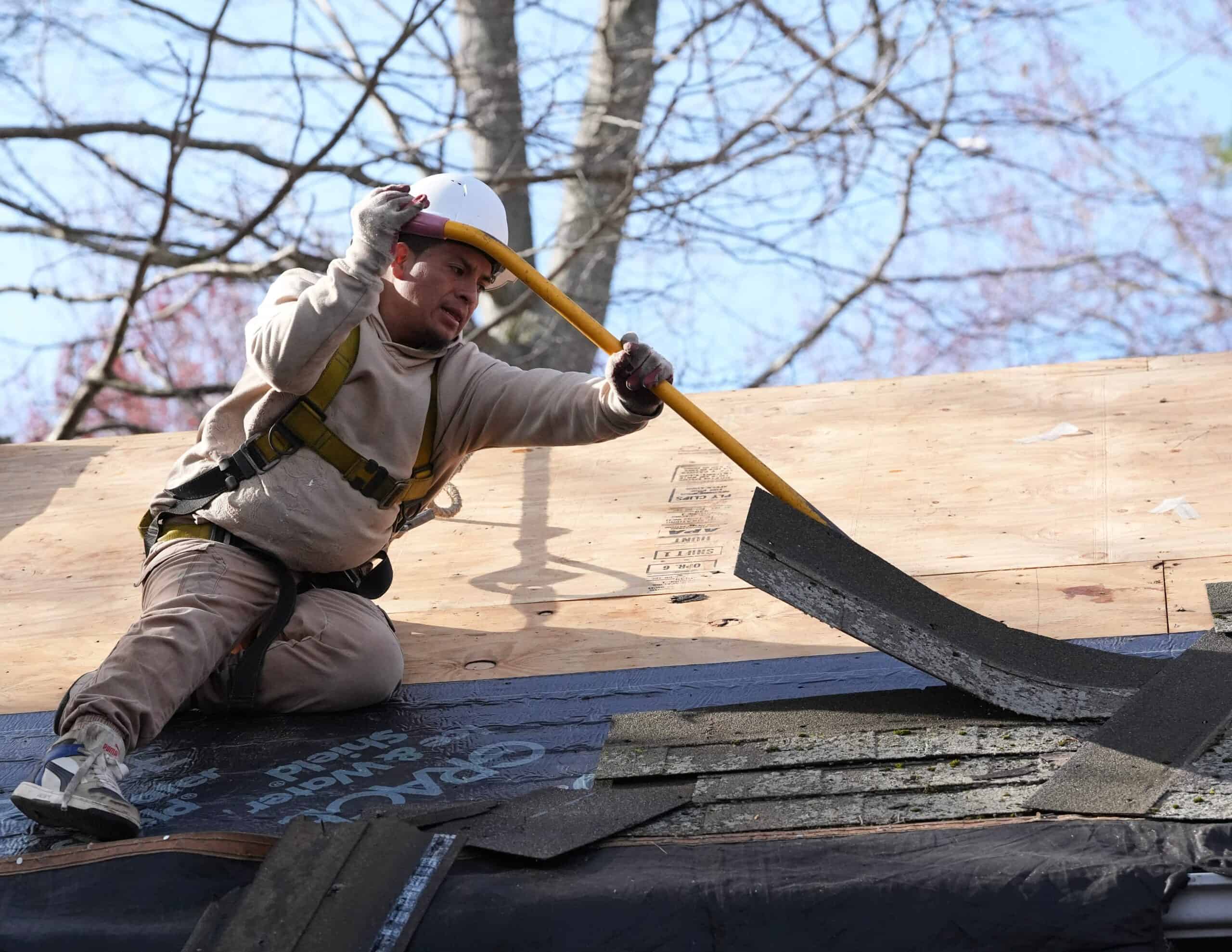
North Hampton is a small town with a serious ocean problem. From Little Boars Head to the back side of Post Road, nothing in town sits more than a few miles from salt water, and the homes along Atlantic Avenue and Route 1A take spray on the wind every time the surf is up. We inspect a lot of roofs here, and the ones near the coast do not age like the ones we see twenty miles inland. They age faster, they age unevenly, and they fail in ways a homeowner standing in the driveway will never spot.
The good news is that salt-air damage is predictable. It shows up in the same places, on the same slopes, in the same order, on almost every house. A proper roof inspection catches it while it is still a repair instead of a tear-off. Here is what the ocean actually does to an asphalt roof in North Hampton, what we look for when we get on one, and how to know when it is time to have someone take a look at yours.
People picture salt eating through shingles like acid. That is not really how it works. Asphalt and fiberglass do not care much about salt directly. What salt does is keep things wet. Salt crystals settle on the roof, grab humidity out of the morning fog, and hold a thin film of moisture on the shingle surface long after a dry roof inland would have baked off. A shingle that stays damp sheds granules faster, grows algae sooner, and gives winter ice more to work with.
The second thing salt does is attack metal. Every asphalt roof is full of steel and aluminum: the nails under every shingle, the drip edge along every eave, the step flashing against every sidewall, the chimney counter-flashing, the pipe boots, the ridge vent. Salt air corrodes all of it years faster than inland air does. We pull nails out of ocean-side roofs in this town that have rusted down to half their original shank. A rusted nail loses its grip, backs out, and lifts the shingle above it. Now the wind has an edge to grab.
And the wind gets plenty of chances. The same exposure that salts the roof also loads it. Nor’easters come ashore here with gusts that work shingle sealant strips like a pry bar, and once a bond line cracks, wind-driven rain and salt get under the tab and go to work on the fasteners underneath. Salt, moisture, and wind are not three separate problems on a Seacoast roof. They are one problem that shows up as granule loss on one slope, rust streaks on another, and a lifted tab where you cannot see it at all.
This is the single most common thing we explain to North Hampton homeowners. From the street the roof looks fine, because the street side is the protected side. Get a ladder or a drone on the ocean side and it is a different roof: bald patches at the shingle edges, granules piled in the gutters, rust bleeding from every exposed fastener, sealant strips chalked and cracked.
Houses out by the water, in Little Boars Head or along Ocean Boulevard, show this most dramatically. But it holds inland too. The wind that funnels up over the marsh does not stop at Route 1. A colonial on Post Road still has a windward plane and a leeward plane, and the windward one is still the one we find problems on. This is why we treat a coastal inspection as a slope-by-slope job. Averaging the whole roof into one condition rating hides exactly the information the homeowner is paying for.
A real inspection is a checklist, not a glance. On the roof itself, we start with the metal because the metal fails first: drip edge, step flashing, chimney flashing, vent stacks, and the fasteners everywhere. Rust streaking down a slope is never decoration. It is a sign the hardware under the shingles is further gone than the shingles are.
Then the shingles, slope by slope. We are looking for the salt-air signature: granule thinning concentrated on the ocean-facing plane, edges starting to curl where the mat has dried out, tabs that lift by hand because the sealant bond let go in a blow two winters ago and never re-adhered. A shingle that lifts silently is more dangerous than one that is visibly torn, because nobody calls us about a shingle that looks fine from the ground. If you have already lost tabs, our guide to replacing missing shingles covers what that repair looks like done right.
Finally the attic, which is where coastal roofs keep their secrets. Moisture staining on the deck, rusty nail tips, compressed insulation, blocked soffit bays. Ocean humidity plus a poorly vented attic means the deck gets attacked from both sides at once. We have written before about attic condensation because it quietly shortens roof life in exactly the homes that can least afford it, and no shingle warranty covers a roof cooked from below.
Inland roofs can get away with an inspection every couple of years while they are young. We do not recommend that near the coast, and North Hampton is all near the coast. The wear mechanisms here are cumulative and quiet. Sealant bonds crack in a February gale but the tab does not blow off, it just sits there unsealed through spring fog and summer humidity, and by the time water finds the nail holes, the stain shows up on a bedroom ceiling in January.
The storm check matters just as much as the annual. After a real blow comes through, walk the property and look for shingle pieces, granule piles at the downspout splash blocks, or anything metal on the lawn. Any of those is reason to get an inspection on the calendar that week, not that season. Wind damage compounds: one lifted tab becomes four the next storm, then a stripped course the storm after that. Our neighbors over in Rye see the identical pattern, which is why we wrote up what oceanfront homes in Rye face from wind and salt. North Hampton is the same ocean with a different zip code.
Nobody wants to hear “replace” a day sooner than necessary, and an honest inspection is what keeps that word out of the conversation for as long as possible. Plenty of the coastal roofs we look at need a few hundred dollars of work: a re-flashed chimney, new pipe boots, a course of shingles on a windward eave, fasteners reset and sealed. Done promptly, those repairs buy years.
What changes the math is when the failures stop being local. Widespread granule loss on the ocean side, shingles that crack when you lift them gently, rust at every fastener line: at that point each repair is a down payment on the next one, and the deck is absorbing risk every month. That is when we start talking about a roof replacement plan, and for exposed sites, sometimes about whether standing-seam metal makes more sense than another round of asphalt against this wind.
Cost questions deserve straight answers, and the straight answer on the Seacoast is that exposure drives everything. A protected cape off Winnicut Road and an oceanfront gambrel at Little Boars Head are different jobs even when the shingle count matches. That is exactly why the inspection comes first and costs you nothing. You get a slope-by-slope picture of where your roof actually stands, with photos, and a clear read on what is urgent versus what can wait a season.
If the answer turns out to be bigger than a repair, we will walk you through the options, including financing, before anyone signs anything. We have been roofing the Seacoast for a long time, we are based one town over in Hampton Falls, and our North Hampton crews are on roofs here every season. Get in touch and we will schedule a look before the next storm does the inspecting for you.
Architectural shingles rated for 30 years routinely give up their last five to ten on exposed coastal sites, with windward slopes wearing fastest. Protected inland roofs in the same town can run closer to full rated life. Maintenance and attic ventilation move the number more than the brochure does.
You can spot obvious problems: missing tabs, rust streaks, granule piles in gutters. What you cannot safely see is sealant bond condition, fastener corrosion under the tabs, or the attic side of the deck. Leave walking a coastal roof to people with harnesses and fall protection. A ground-and-ladder check between professional inspections is smart. Replacing the professional inspection with it is not.
Policies generally cover sudden storm damage, like wind stripping shingles in a nor’easter, and generally exclude gradual wear, which is what salt-air aging is. This is exactly why documented inspections matter: they establish what was storm damage and what was not, which makes any claim you do file much cleaner. Check your own policy for specifics.
Spring and fall are ideal. Spring shows what winter ice and wind actually did, and fall confirms the roof is sealed and vented before it faces another freeze season. If you have never had one, the best time is now, whatever the month. Storm-chasing damage in January is the expensive alternative.
A properly specified standing-seam roof with coastal-rated coatings and stainless or coated fasteners resists salt exposure very well, which is why you see so much metal near the water here. It costs more up front and it is not right for every house or budget. For exposed sites due for replacement, it belongs in the conversation.