
Portsmouth houses are built close together, and a lot of them are built tall and narrow. A South End colonial with a neighbor six feet off each side gets very little daylight into the middle of the house, and the third-floor rooms under the roof get almost none. That is the call we get most from Portsmouth: not “we want a skylight” so much as “the upstairs bathroom has no window and the hallway is dark at noon.” A skylight fixes that in a day, if the roof and the framing will take one.
The other half of our skylight work in the city is repair. Portsmouth has a lot of skylights that went in during the 1980s and 1990s, plastic domes and early insulated glass units that are now fogged, yellowed, or dripping every March. Here is how we think through both jobs, from the harbor neighborhoods out to Elwyn Park.
The short version
- A skylight is a roofing job before it is a window job. The unit matters less than the flashing, the underlayment around the opening, and how the framing is headed off.
- Most Portsmouth roofs take a deck-mounted VELUX skylight. Low-slope roofs, including the flat sections on downtown buildings and some gambrel tops, need a curb-mounted unit instead.
- Adding a skylight cuts roof framing, so it needs a building permit in Portsmouth. Inside the Historic District, a skylight visible from the street can also need Historic District Commission review.
- Most “leaking” skylights we open up are either winter condensation or failed flashing. The glass itself is rarely the problem unless the seal has fogged.
- The cheapest time to add or replace a skylight is during a roof replacement, when the deck is already open and the flashing kit goes in with the new shingles.
Which Portsmouth homes are good candidates for a skylight?
Walk the older neighborhoods and you can see why skylights are so common here. Houses sit tight to the lot lines, so side windows look straight into a neighbor’s clapboards. Three-story colonials near Strawbery Banke have finished attics with one small gable window at each end and a long dark hallway between. The wartime houses in Atlantic Heights and the post-war capes in Pannaway Manor and Elwyn Park have upstairs rooms tucked under the roof with kneewalls, which means the only place daylight can come from is straight up.
What we look at on the first visit is the roof over that room, not the room. We want a pitch that VELUX rates for a deck-mounted unit, rafters we can head off without touching a load path, and a clear run for the light shaft down to the ceiling. Where the roof is low-slope, or the rafters are shallow 2x4s in a house from 1900, the answer changes, and we will say so on the spot rather than sell a unit that will fight the house.
What does a skylight installation actually involve?
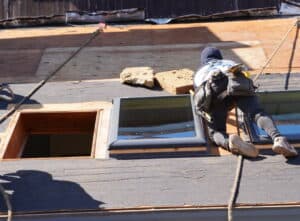
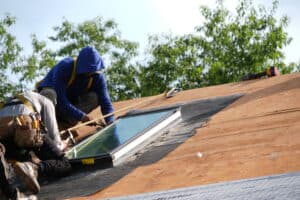
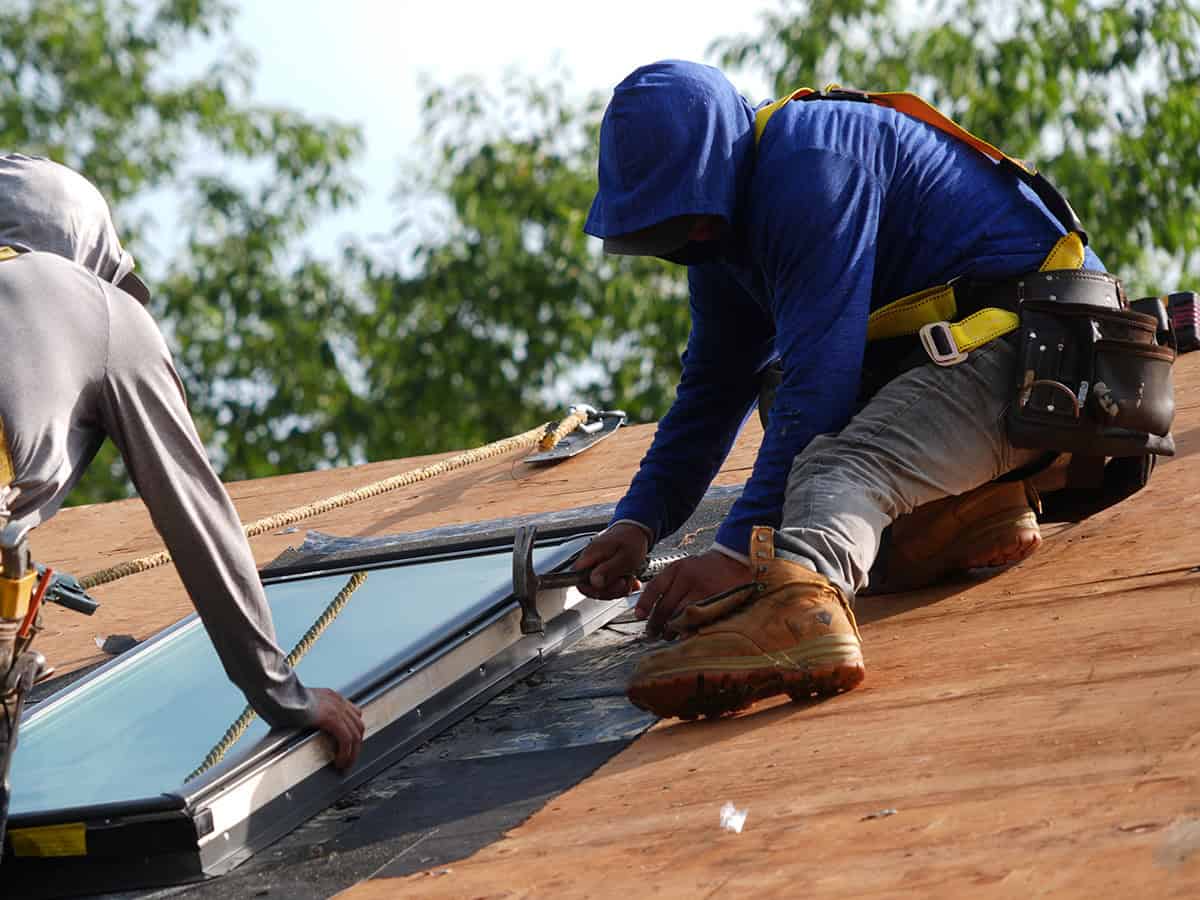
The order of operations is what separates a skylight that lasts from one that leaks in its third winter. Once the opening is cut and headed off, we run ice and water shield up onto the curb of the unit and out onto the deck on all four sides, so water that ever gets past the metal has a sealed path back onto the roof. Then the flashing kit goes in from the bottom up, sill flashing first, step flashing woven with each shingle course up the sides, and the head flashing tucked under the courses above. Nothing depends on caulk.
Inside, the light shaft is where a lot of installers cut corners. We frame it, insulate it, and finish it so the shaft does not become a cold chimney that sweats every January. A straight shaft gives the most direct light; a flared shaft spreads it across a bigger room. On the tall houses in the South End, the shaft can be several feet long, so we talk through the geometry before anyone cuts drywall.
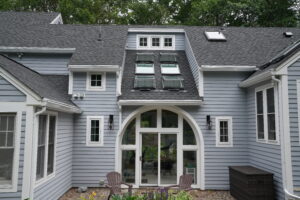
The units themselves are all VELUX, which is the only brand we install, with fixed, manual venting, and solar-powered venting models. The solar units open and close from a remote and shut themselves when the rain sensor gets wet, which matters on the Seacoast, where a squall can come in off the water while you are at work. More on the product line is on our skylight installation and repair page.
Deck-mounted or curb-mounted: which does a Portsmouth roof need?
Portsmouth has more low-slope roofs than most Seacoast towns. Downtown, the mixed-use buildings on Market, Congress, and State streets often have flat or nearly flat roofs behind a parapet. The gambrel roofs common in the older neighborhoods have a steep lower slope and a much flatter upper slope. Skylights on those upper slopes, or on a flat commercial roof, want a curb, because water sits longer and a deck-mounted unit is not designed for it.
A curb also makes replacement simple later. The curb stays, the roofing ties into it, and a new unit drops on top when the old one has run its life. If a house already has curb-mounted skylights from a previous owner, we will usually keep the curbs, check that they are tall enough for the current roofing, and replace only the units and the flashing.
Do you need a permit to add a skylight in Portsmouth?
This is the part of a Portsmouth skylight job that surprises people who moved here from a town with looser rules. A large part of the older city is inside the Historic District, and the commission reviews changes to exterior surfaces that can be seen from the street. A skylight on the rear slope of a South End colonial is normally a straightforward conversation. The same unit on the front slope facing the sidewalk may not be. We will tell you which case you are in before you get attached to a location, and we will route the skylight to the back or the side roof when that gets the light you want without a hearing.
Outside the district, the building permit is the only step. We pull it as the contractor, schedule the framing inspection if the inspector wants to see the headers before we close up, and keep a copy for your file. If you ever sell, the buyer’s home inspector will ask about it.
Why do skylights leak, and is yours really leaking?
Condensation fools a lot of homeowners. A skylight over a bathroom or a kitchen sees a lot of warm, wet air, and on a February morning the glass is the coldest surface in the room. Water forms on the inside, runs down, and drips off the bottom edge onto the sill or the floor. It looks exactly like a leak and it stops the moment the weather turns. The fix is ventilation and a properly insulated shaft, not roof work. We wrote about the winter side of this in our post on why snow around skylights goes unnoticed in winter.
Flashing failures are the real leaks. The pattern we see most in the city is a roof that was replaced ten or fifteen years ago by a crew that shingled around the existing skylight and reused the old flashing, or, worse, buried the joint in roofing cement. Cement cracks in two or three winters of freeze and thaw. Once the step flashing is compromised, wind-driven rain off the harbor finds the gap during every nor’easter, and the stain shows up on the ceiling a foot or two downhill of the skylight.
Fogged glass is the third case. When the seal on an insulated glass unit fails, moisture gets between the panes, the glass looks permanently hazy, and in cold snaps it can drip from the inside. That is not repairable. The unit gets replaced.
Should you repair or replace an old skylight?
The acrylic bubble skylights that went into so many Portsmouth houses in the 1980s are the easiest call. The plastic goes cloudy and brittle, the seal at the base fails, and the light they let in is a dull gray. Replacing one with a glass VELUX unit in a new deck-mounted opening is usually a one-day job, and the difference in the room is immediate. Newer glass also carries low-E coatings that cut the summer heat gain we covered in our post on how skylight UV exposure affects attic comfort.
Where the unit is a good glass skylight from the last 15 years and the only problem is a bad reroof around it, we reflash. That means lifting the shingles around the opening, removing the old flashing and any cement, running new ice and water membrane, and installing the correct VELUX flashing kit for that model and that roofing. It is a half-day repair that solves the leak for good.
Is it better to add skylights during a roof replacement?
We say this on nearly every Portsmouth replacement estimate. If there is a room you have wanted more light in, the reroof is the moment. And if the house already has skylights that are 15 or 20 years old, replacing them while the roof is off is the right move even when they are not leaking yet, because the new roof will outlast them and nobody wants to open up a five-year-old roof to swap a skylight. Our post on roof replacement in Portsmouth walks through how we plan the whole job.
Skylights also go on metal roofs. We install standing-seam roofs across the Seacoast and set VELUX units with the metal-roof flashing kit, which is built for the panel profile instead of shingle courses. The detailing is different, but the principle is the same: the flashing is part of the roof system, installed by the roofing crew, not a trim piece added afterward.
Who installs and repairs skylights in Portsmouth, NH?
Skylights are a small share of what we do in Portsmouth, and that is the point. We are on the city’s roofs every week for roofing in Portsmouth, full replacements, repairs, and gutters, so a skylight goes in by people who spend their days making roofs not leak. A window company sends a window installer up a ladder. We send the crew that built the roof.
Every skylight job starts with a look at the roof, the attic, and the room. You get a straight answer about whether the roof will take the unit, what the permit situation is for your address, and a written number for the whole job, including the light shaft. We do not quote skylights from the driveway. If the project is part of a larger roof, financing options are available, and you can schedule a free estimate for the skylight alone or the full roof replacement.
Frequently asked questions
How long does a skylight installation take?
For one or two units on a shingle roof, the roof work is done in a day. The light shaft inside takes another day or so for framing, insulation, and drywall, and a painter finishes after that. Adding a skylight during a roof replacement adds very little time to the job, since the crew is already working that section of the deck.
Do skylights cause ice dams?
A badly insulated skylight shaft can. Warm air rising through an uninsulated shaft heats the roof deck around the unit, melts snow above it, and the water refreezes at the eave. A properly insulated and air-sealed shaft keeps the deck cold. Where we see ice building around a skylight every winter, the shaft is the first thing we check.
Can a skylight be installed on a standing-seam metal roof?
Yes. VELUX makes flashing kits specifically for metal roofing, and we install skylights on the standing-seam roofs we build across the Seacoast. The flashing ties into the panel ribs rather than shingle courses, so it is a different detail, but the unit and the framing are the same. It is easiest to plan the skylight when the metal roof is installed.
What is the difference between a skylight and a roof window?
A skylight is set high on the roof, out of reach, and is either fixed or opened by a crank, a rod, or a solar-powered motor. A roof window is mounted within reach, in a finished attic or a loft, and opens like a window so you can look out and even clean the outside of the glass from inside. VELUX makes both, and we install both.
Will a venting skylight leak in a nor’easter?
Not when it is flashed correctly and closed. A venting VELUX unit seals the same as a fixed one when shut, and the solar-powered models close themselves when the rain sensor gets wet. What leaks in a nor’easter is bad flashing or old roofing cement around the opening, which wind-driven rain off the water finds every time. That is a flashing repair, not a reason to avoid a venting unit.