
Every February we get the same phone call from somewhere between Seabrook and Kittery. The homeowner has watched three weeks of hard cold, then a two day thaw with rain, then single digits again, and now there is a wet spot on the ceiling under the eave or a scatter of granules on the walk. The question is always some version of the same thing: can a shingle roof really take this, or is the weather slowly taking the roof apart?
The honest answer is that a well installed asphalt shingle roof handles a Seacoast winter fine, and a roof with one weak spot does not. Repeated deep freezes do not usually cause damage on their own. They find the damage that was already there and make it worse, fast. We put shingle roofs on Capes and Colonials from our shop in Hampton Falls and our office in Salem, and we see the same handful of failure points every spring. Here is what the cold is actually doing up there, which parts give out first, what to look for after a thaw, and when a freeze problem is a repair rather than a new roof.
The short version
- Asphalt shingles are built to flex. Deep cold makes them stiff and brittle for a while, and the thaw brings them back. A good shingle on a good deck goes through that cycle for twenty years or more without complaint.
- The damage comes from water that gets in during the thaw and then freezes in place: under lifted tabs, behind flashing, in nail holes, in a plugged gutter. Ice takes up more room than water, and it pries.
- Repeated short cycles are harder on a roof than one long cold stretch. Each cycle is one more push on the seal strips, one more lift of ice at the eave, one more pump of water through a small gap.
- The eaves, the valleys, the flashing around chimneys and skylights, and any shingle that never sealed are where we find the trouble. The open middle of the roof is almost never the problem.
- Most freeze damage on a roof under fifteen years old is a repair. A roof that is losing granules, curling across whole slopes, or leaking in more than one place after a thaw is telling you it is time to plan a replacement.
What happens to an asphalt shingle when the temperature drops below freezing?
An architectural shingle is a fiberglass mat soaked in asphalt, topped with ceramic granules, with a strip of adhesive sealant across each course that bonds to the shingle above it once the sun warms it. In warm weather every part of that is forgiving. Asphalt flexes, the seal strip grips, and the granules shed water and UV.
Below freezing the asphalt goes stiff. The shingle is still doing its job, it is just not interested in moving. That matters for three reasons. A shingle that never sealed in the fall, because it went on late or sits on a shaded north slope, will not seal now either, and a stiff unsealed tab is exactly what a nor’easter wind wants to get under. Anyone walking a cold roof can crack shingles that would have been fine to walk in May. And any water that found its way under a shingle or into a nail hole during the thaw is now ice, pushing up on a shingle that cannot give.
The warm weather side of the product is on our asphalt shingle roofing page. The winter side is simple to say: keep water out from under the shingle in the first place, and the cold has nothing to work with.
Why do repeated deep freezes hurt a roof more than one long cold stretch?
If you have ever watched a pothole open up on Route 1 in March, you already understand this. Steady cold is not what breaks pavement. Water gets into a crack during the day, freezes overnight, expands, and the crack is a little wider in the morning. Then it fills a little deeper the next day. Your roof is going through the same thing, just slower and quieter.
The Seacoast gets more of these cycles than inland New Hampshire because the ocean keeps our daytime highs hovering right around freezing for weeks at a time. A January in Rye or Hampton can swing above and below thirty two degrees almost every day, where a town forty miles inland might stay locked below freezing for the whole month. That is why we wrote a separate piece on what makes Hampton roofs especially vulnerable to winter thaw cycles. Salt air and open exposure add to it, but the swing is the core of the problem.
Here is the part homeowners tend to miss. The water doing the damage is not snowmelt running down the shingles. It is water that got under the surface through a lifted seal, a bare nail head, a split pipe boot or a gap in step flashing. Under there it cannot drain, so it sits, freezes and lifts, and every thaw lets a little more in behind it.
Which parts of a shingle roof fail first in a New Hampshire winter?
When we walk a roof after a hard winter, we are not looking at the whole slope. We go straight to the places water concentrates or changes direction, because that is where the freeze does its work.
The eaves. Heat leaking from the house melts the bottom of the snowpack. The water runs down to the overhang, which is cold because there is no heated room under it, and refreezes into a dam. Water backs up behind the dam and under the shingles. This is the single most common winter leak we see on older Capes, and it is why we put ice and water shield along the eaves on every roof we replace. The membrane is the backup for when a dam forms anyway. Our post on roof ventilation and preventing ice dams covers the fix at the source.
The valleys. Two slopes feed one trough, so a valley carries more water than any other line on the roof and holds ice longer. A valley that was woven or cut tight when the roof was new will still be fine. A valley with a lifted shingle edge or a crack in the metal is where we find the stain in the ceiling below.
Flashing. Chimneys, skylights and the wall where a dormer meets the main roof all depend on metal flashing and sealant. Metal and asphalt expand and contract at different rates, and after enough cycles the sealant bead lets go. We wrote about this at length in why roof flashing fails more often after harsh winters.
Nail heads and unsealed shingles. A nail driven high or crooked leaves its head exposed. Water gets to the shank, freezes, and backs the nail out a hair each cycle, and by spring you have a nail pop and a tab that lifts in the wind. A shingle that went on late in the fall on a shaded slope may not seal until May, so through its first winter it is held by nails alone while every thaw lets the wind test it.
Do architectural shingles handle deep freezes better than the old three tab roofs?
Most of the roofs we replace on the Seacoast are three tab shingles from the nineties or early two thousands. They were a good product for the money, but they are a single layer of mat with a lot of exposed edge, and after twenty years of our winters the tabs curl, the seal strips let go, and the granules wash into the gutters.
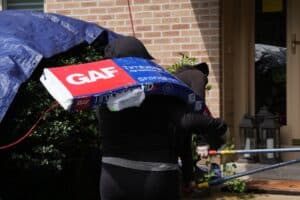
The GAF Timberline HDZ architectural shingles we install today are a laminated two layer shingle with a wider nailing zone and a seal strip that bonds across the full tab. They move less through the freeze cycle, and when the wind comes off the water in a February storm a sealed architectural shingle stays put where an old three tab would have folded back. In southern New Hampshire a shingle roof realistically gives you twenty two to twenty five years, and the winters are most of the reason it is not thirty.
The shingle is still only one of four layers that decide how a roof handles the cold. The other three are the deck, the underlayment, and the attic. Get the attic wrong and no shingle on the market will keep the ice dams off.
How does the attic underneath decide how the roof handles winter?
This is where most freeze damage actually starts, and it is the part of the roof nobody looks at. If you can see daylight through the soffit vents from inside the attic and feel a draft at the ridge, the attic is doing its job. If it is warm enough to be comfortable in January, your house is paying to melt the snow on the roof, and that water is heading for the eaves.
The same warm, moist air also condenses on the cold underside of the deck. In the morning the plywood is frosted, by afternoon it drips, and homeowners call us about a roof leak in February where we find a dry roof over a wet attic. We keep one page on that subject: attic condensation and how we deal with it. On every replacement we look at the ventilation path before the first shingle goes on, because a ridge vent and clear soffits are often the cheapest part of the job and do the most for the next twenty winters.
What should you check on a shingle roof after a freeze and thaw stretch?
You do not need to climb anything to catch most of it. Walk the house after the thaw with the sun behind you and look for shingles that sit higher than their neighbors, dark patches on a light roof or light patches on a dark one, and a line of icicles that is thicker in one spot than the rest. Thick icicles over one window usually mean a dam forming above it. We put together a full checklist in how to spot hidden ice damage in asphalt shingles after a cold snap.
Look at the gutters while you are out there. Gutters that have pulled off the fascia or sag between hangers have been carrying ice, and the same freeze that bent the gutter was working on the shingles above it. That failure gets its own post: why gutters pull away from freeze and thaw stress.
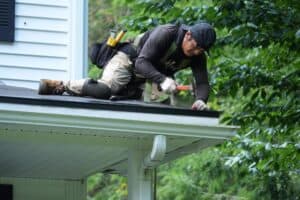
Then go up into the attic with a flashlight on a cold morning. Frost on the nails or the underside of the deck means warm moist air is getting up there. Dark streaks down the plywood or wet insulation at the eave line means water is getting in from above. Both get worse if they wait until summer. What we ask people not to do is get on the roof. A cold shingle roof with a dusting of snow is as slick as it will ever be, and the shingles under it are as brittle as they will ever be. The roof rake, used from the ground on the bottom few feet of the eave, is the one piece of winter roof work that is safe to do yourself.
When is freeze damage a repair, and when is it time to replace the roof?
Age is the first question we ask. Freeze damage on a roof that is eight years old is almost always a localized problem with a localized fix: reseal a run of tabs, replace a cracked boot, reflash a chimney, add ice and water shield at a problem eave. That is the work our roof repair crew does all spring, and it is the right call when the rest of the roof is sound.
The picture changes on a roof that is pushing twenty. The same freeze that lifted one shingle has been working on all of them, and a repair on a brittle, granule bare roof tends to be the first of several. If the deck feels soft at the eaves, the plywood has been wet more than one winter, and we would rather give you a straight answer about roof replacement than sell you a patch we know will not hold. We do not quote numbers in a blog post because the honest number depends on the house, the pitch and what we find when the old roof comes off. We do offer financing on roof replacement, and a free estimate costs you nothing but an hour.
How we install shingle roofs on the Seacoast so the winter is not a surprise
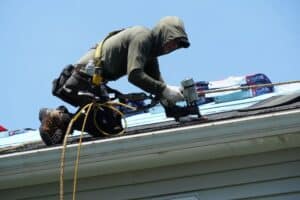
Everything above is easier to prevent than to fix, and most of the prevention happens on install day. On every roof we replace between the Hampton Falls area and Portsmouth, the sequence is the same. The old roof comes off to bare deck. Rotten or delaminated plywood gets replaced, not covered. Ice and water shield goes down along every eave, in every valley, and around every penetration, so that when a dam forms anyway the water meets a membrane instead of bare wood. Synthetic underlayment covers the rest of the deck. Starter strip goes on at the eaves and rakes so the first course is sealed against wind from the start.
Then the shingles go on with the nails in the nailing zone, flush, not high and not overdriven, because a high nail is a future nail pop and an overdriven nail is a cut mat. Chimneys and sidewalls get step flashing and counterflashing in metal, not a bead of caulk doing the metal’s job. The ridge gets a vent so the attic can breathe. None of that is a secret. It is the difference between a roof that goes through thirty freeze and thaw cycles a winter for twenty years and one that needs us back in March. If your roof is showing any of the signs above, or you want to know how it is holding up before the next cold snap, request a free estimate or call us in New Hampshire at (603) 686-7763.
Frequently asked questions
Can asphalt shingles crack from cold weather alone?
Rarely. A sound shingle that is left alone in deep cold just sits there stiff until it warms up. Cracking happens when a cold, brittle shingle is forced to move: by ice lifting from underneath, by someone walking on it, or by wind getting under an unsealed tab. Keep water out from under the shingles and stay off the roof in winter, and the cold by itself is not the problem.
Should I rake the snow off my shingle roof?
Pull the bottom three or four feet off the eaves with a roof rake from the ground after a heavy storm. That removes the snow that feeds ice dams without putting you or your shingles at risk. Do not scrape down to the shingle, do not chip at ice, and do not climb up. If the dams keep coming back every winter, the fix is in the attic, not on the roof.
Can you replace a shingle roof in the winter in New Hampshire?
Yes, and we do when a roof cannot wait. The crew works around the weather, the deck is kept dry, and the shingles are installed knowing the seal strips will not bond until the first warm stretch in spring. A winter install done right is a sound roof. What we will not do is shingle over a frosted or wet deck, so some days we wait.
Why does my roof make popping noises on cold nights?
Wood, metal and asphalt all shrink in the cold and at different rates. The pops and cracks you hear on a single digit night are the deck, the rafters and the flashing moving against each other, not the roof failing. If the noise is new on a roof that has been quiet for years, or it comes with a stain on the ceiling, have it looked at. Otherwise it is the house breathing.