
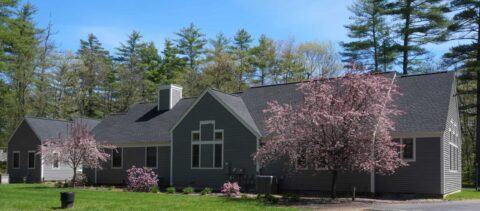
A condo roof is the only roof we replace where the person who calls us is almost never the person who lives under it. The call comes from a board president, a property manager, or the one owner who got voted into dealing with it, and the first question is rarely about shingles. It is about process. Who has to approve this? How do we do nine buildings without the whole community living under tarps? What do our owners need to be told, and when? What paper does the association need from the roofer before anyone climbs a ladder?
We have replaced roofs for condo associations, HOA boards and property managers from the converted mill buildings in Dover to the planned neighborhoods in Stratham and the newer developments along the Seacoast, and the roofing itself is the part we worry about least. What goes wrong on an association job almost always happens before the first dumpster arrives: a vague spec that produced three bids for three different roofs, a phasing plan nobody wrote down, an owner who came home to a crew on her building with no warning. This is how condo and HOA roof replacement works in New Hampshire, in the order a board actually meets it.
The short version
- Under New Hampshire’s Condominium Act, maintenance and replacement of the common areas belongs to the unit owners’ association, and the roof is common area in nearly every declaration we have read. Your declaration and bylaws govern, so start there, not with a roofer.
- The board approves the scope, the product and the color once, in writing, before anyone bids. A spec sheet that every bidder prices the same way is the only thing that makes three quotes comparable.
- Phasing is a schedule, not an afterthought: buildings sequenced by condition and access, every building weathertight by the end of its day, owners told the week before their building, parking and dumpster locations mapped before the first delivery.
- Before the contract is signed, the association should hold the roofer’s certificate of insurance naming the association as additional insured, proof of workers’ compensation, and the manufacturer certification the warranty depends on. New Hampshire does not license roofers, so this paper is the vetting.
- Whether the money comes from reserves or a special assessment is a board and documents decision. What a roofer can do is inspect early and report by building, so the roof is budgeted for instead of discovered.
Who is responsible for replacing the roof on a New Hampshire condo?
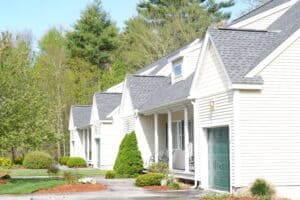
The Condominium Act sets the default: the association takes care of the common areas, the owner takes care of the inside of the unit, and the condominium instruments can move that line. On a garden-style building with eight units under one continuous roof there is no practical way to split it. Townhouse-style communities are where it gets interesting. Some declarations make each roof a limited common area assigned to the unit beneath it, some make the owner responsible outright, and some leave the association in charge of replacement but the owner in charge of repairs. We have been handed all three versions.
So the first conversation we have with a board is not about shingles. It is: have you read the declaration and the bylaws on this, and has your counsel? If the roof is owner responsibility, the association’s role may be limited to approving the product and color, and each homeowner is a separate customer with a separate contract. If it is association responsibility, the common case, the board is the customer for the whole community and everything below applies. That answer decides who signs, who pays and who holds the warranty, so it is worth settling before a single bid is requested.
What does the board have to approve before a condo roof replacement starts?
The board acts on behalf of the association, and its members are held to the care and loyalty of a corporate director under RSA 356-B:40. In practice that means the roof decision gets documented: a vote on the scope, a vote on the award, and minutes that show both. The communities that move fastest settle the specification before talking to any roofer.
What we hand a board to approve is a one-page specification a non-roofer can read: the shingle by manufacturer and product line, with the approved color named; the underlayment and the ice barrier coverage at eaves and valleys; the ventilation plan, because many older association buildings were built with no ridge vent and the attic ventilation gets fixed at reroof time or never; new drip edge, pipe boots and flashing rather than reused; a decking allowance priced per sheet; and daily cleanup with magnetic nail sweeps of lawns and parking. Once the board signs that page, every bidder prices the same roof, and the approved color is on file for the next twenty years.
How should an association get comparable bids for a condo roof?
Association bids come back all over the map not because one roofer is cheating but because each one measured differently, assumed a different waste factor, priced decking a different way and quoted a different shingle. A lump sum for the whole community hides all of that. A roof priced building by building, with the squares written next to each one, lets the board see where the numbers diverge and ask why.
Decking is the other place to be careful. Nobody can see the plywood until the old shingles come off, so every honest bid carries an allowance for replacing rotten sheets. Make every bidder state that allowance per sheet and ask how they document it. We photograph every sheet we replace, with the building and the location in the frame, and the manager gets those photos with the invoice. For the rest of the vetting, including the state guidance on written estimates and the insurance lookups, our guide to vetting a roofing contractor in New Hampshire applies to boards exactly as it does to homeowners.
How is a multi-building condo roof replacement phased?
Phasing is where association jobs are won or lost, and it starts with the inspection, not the calendar. Buildings with active leaks or exposed decking go first. Buildings with the worst access, tight courtyards, carports underneath, a steep rear slope over a wetland buffer, get the longest clear-weather window we can find. The order is written down, shared with the board and the manager, and revised in writing when weather moves it.
Our rule on every job, and the one we would put in any association contract, is that no building is opened that cannot be closed the same day. A crew tears off only what it can dry in and shingle before dark, so no owner sleeps under a tarp because the forecast changed. For the manager, phasing also means a map: where the dumpster sits for each building, which parking spaces close on which days, where the material drop goes. We hand that over with the schedule, because the manager is the one who will field the phone calls.
What notice do condo owners need before roofing work starts?
RSA 356-B:37-a sets how association notices are delivered, and RSA 356-B:41 covers access: the association gives prior notice before entering a unit, and the owner cannot willfully refuse access the association reasonably needs after adequate notice. Reroofing rarely requires going inside, but it can: checking attic ventilation, confirming a bath fan is actually ducted outside, looking at a stain an owner has been worried about. We ask the manager to route those requests through the association’s normal notice channel, so the paper trail is the association’s.
The notice should tell owners what the day will be like, not just that it is coming. Move vehicles out of the marked spaces. Take pictures and mirrors off top-floor walls, because tear-off and nailing vibrate through the framing. Cover anything stored in the attic, since old nails and grit fall between the rafters. Keep pets inside and children off the lawn until the magnetic sweep is done. Tell us about skylights, satellite dishes and anything on the roof that is yours. A calm community is the difference between a reroof the board gets thanked for and one it hears about at the annual meeting.
What insurance paperwork should the association collect from the roofer?
New Hampshire does not license roofers, so the association’s protection is the paperwork and the people. The state’s workers’ compensation coverage verification lookup is free, and the certificate should come from the agent, not forwarded by the contractor. Products and completed operations coverage is what responds if a roof installed this year leaks into a unit two winters from now, and it is the line boards most often forget to look for.
The association’s own coverage is the other half. RSA 356-B:43 requires the association to carry a master casualty policy for the full replacement value of the structures and common areas, and a master liability policy, and to notify owners of changes to them. A new roof changes the replacement value and the risk, so tell the association’s carrier when the project is done. We provide the certificate, the endorsement and the manufacturer certification to the manager before the contract is signed, and again to the association’s insurance agent on request.
Can a condo roof be replaced in the winter in New Hampshire?
We work through New Hampshire winters, and we are honest with boards about what that means. Shingle self-seal strips need warmth and sun to bond, and on a north slope in January they may not get it until spring, so on cold-weather installs we hand-seal the exposed edges and the rakes where wind lift happens. Days are short, which means fewer squares per day and a longer phasing calendar. None of that stops the job. All of it goes into the schedule.
The better answer for most associations is timing the decision. A board that walks the buildings with us in August, approves the spec in September and awards in October holds the best spring and summer windows for the exposed buildings. A board that discovers the roof in February, usually because of ice dams and a top-floor leak, is deciding under pressure. Ice dams on association buildings are almost always a ventilation and insulation problem showing up as a roof problem, and we would rather fix the cause at reroof time than patch the symptom every winter.
What about flat roofs, mill conversions and mixed roof types in one community?
The converted mills in Dover are the clearest example. The building is brick, the roof is low slope, and the right answer is a membrane system installed by a crew certified to do it. Newer developments mix systems on purpose: architectural shingles on the units, a membrane over a flat-roofed community building, metal over porches. If three contractors replace those over ten years, the association ends up with three warranties, three flashing details where the systems meet, and nobody responsible for the seam between them. Our commercial roofing crews and our residential crews work for the same company, so an association can hand us the whole community.
Low-slope roofs also give a board an option a shingle roof does not. When the deck and insulation under an aging membrane are dry, a roof coating system can restore it and buy years without a tear-off, which is often treated as maintenance rather than a capital project. When the substrate is wet, coating it traps the problem, which is why we take core samples first. If the clubhouse roof is already bubbling, that question has mostly answered itself. For how we choose between membrane options on a working building, see our guide to flat and low-slope commercial roofing in Portsmouth.
How do reserves and special assessments fit into the roof decision?
We do not tell boards how to fund a roof, and we are wary of any roofer who does. The Condominium Act puts budgets on the board under RSA 356-B:40 and gives the association a lien for unpaid assessments under RSA 356-B:46, which is why owners take special assessments seriously and boards would rather not levy them. What we can do is make the decision less of a surprise. A building-by-building inspection, repeated every few years, tells the board which roofs have five years left and which have one, so the treasurer can plan rather than react.
Phasing helps here too. There is no roofing reason a twelve-building community has to be done in one season, and there are good budget reasons to do the four worst buildings this year and the rest over the next two, as long as the specification, the color and the contractor stay the same so the community does not end up with roofs that do not match. Individual owners in communities where the roof is owner responsibility can ask us about financing on their own contract. Association work is priced to the association, in a written proposal, after we have walked every building.
What should the association have in hand when the job is done?
The finish on an association job is paperwork as much as cleanup. Every building gets completion photos: the roof, the flashing details, the ventilation, the decking that was replaced and where. The manufacturer warranty is registered to the association, not to a board member who will move in three years, and the confirmation goes in the manager’s file. As a GAF Master Elite contractor we can offer the enhanced manufacturer warranties available only through certified installers, and on membrane roofs our Carlisle and GAF certifications do the same job. A warranty is only real if it is registered, so we send the proof.
Then the site. Daily magnetic sweeps during the job and a final one when the last dumpster leaves, across lawns, walkways, parking and play areas. Gutters checked and cleared, because tear-off grit ends up in them; if the community’s gutters were due anyway, reroof time is when to do them. After that, a maintenance plan: a seasonal inspection of flashing, seams and ponding on the low-slope sections, documented with photos, so small repairs stay small and the roofs reach the life the board paid for. That is how a condo roof should end, with the manager holding a folder, not a phone number.
If your board is somewhere between “we think the roofs are getting old” and “we have three bids that do not match,” the useful next step is a walk-through. We inspect every building, put the findings in writing by building, and give the board a specification it can send to anyone. Request a free estimate or call (603) 686-7763 from New Hampshire and (207) 360-4800 from Maine. For everything we install on association and residential buildings, see our roofing services, and for the people who will be on your buildings, meet the team.
Frequently asked questions
Does every unit owner have to agree to a condo roof replacement in New Hampshire?
Usually not. When the roof is common area, the board acts on behalf of the association and approves common-area replacement as part of its duties, within whatever limits the declaration and bylaws set. Some documents require an owner vote above a spending threshold or for a special assessment. Read your declaration and bylaws, and ask your association’s counsel before relying on either answer.
Who holds the warranty on a condo roof?
When the association is the customer, the manufacturer warranty should be registered in the association’s name and the workmanship warranty should run to the association, so it survives changes on the board and owner turnover. In communities where each owner is responsible for their own roof, the warranty belongs to that owner. Ask for the registration confirmation before final payment.
Can one owner replace just their section of a shared condo roof?
Not without the association’s approval, and on a continuous roof it rarely makes sense. RSA 356-B:42 gives the association the power to approve or deny changes to the exterior appearance, and a shingle roof over several units is one system; stopping new shingles at a unit line creates a seam that leaks and a color mismatch. If one unit has a leak, the association should treat it as a repair on the common roof.
How long does a condo roof replacement take per building?
A typical garden-style or townhouse building with a straightforward gable roof is torn off and shingled in one to two days by a properly sized crew, longer for cut-up roofs with dormers and valleys, decking replacement, or short winter days. A whole community is measured in weeks, phased building by building, and the written schedule from the roofer should show each building’s window.
What happens if the roofer finds rotten decking under one building?
It gets replaced before the new roof goes on, billed against the per-sheet decking allowance in the contract, and documented with photos showing the building and the location of every sheet. The manager should receive those photos with the invoice. A bid with no decking allowance at all is a bid that will grow on day one, so make every bidder state the allowance up front.
Sources
- New Hampshire RSA 356-B:41, Upkeep of the Condominium (common areas to the association, units to the owner; notice before entry; access after notice)
- New Hampshire RSA 356-B:42, Control of the Common Areas (approval of changes to exterior appearance; architectural control committee)
- New Hampshire RSA 356-B:43, Insurance (master casualty policy at full replacement value; master liability policy; notice to owners)
- New Hampshire RSA 356-B:40, Members of the Board of Directors and Officers (board acts for the association; standard of care; budgets)
- New Hampshire RSA 356-B:37-a, Notice to Unit Owners
- New Hampshire RSA 356-B:46, Lien for Assessments
- New Hampshire workers’ compensation coverage verification lookup
- J. Carnes & Son Roofing, GAF Master Elite contractor listing