
Stratham sits just far enough from the water that people assume the coastal rules do not apply here. They do. The wind that comes up the Squamscott and across Great Bay does not check the town line, and the roofs we work on along Portsmouth Avenue and up around Stratham Hill take the same nor’easters as the ones in Rye, just with more trees involved. So when a Stratham homeowner starts collecting roofing quotes, they are shopping for the same thing an oceanfront homeowner is: a crew that understands Seacoast weather, not a crew that happens to own ladders.
Here is the uncomfortable truth about hiring a roofing contractor in Stratham: the state of New Hampshire will not vet them for you. Anyone with a pickup and a Facebook page can call themselves a roofer here, legally. That puts the vetting job on you, and most homeowners have no idea what to ask. We have been on the other side of this conversation for years, and we can tell you exactly which questions make a good contractor comfortable and a bad one squirm. Ask these before anyone sets a ladder against your house.
The short version
- New Hampshire has no statewide license for roofing contractors, so the state does no vetting for you. Insurance certificates, references, and a real local address are your screening tools.
- Ask for the certificate of insurance to be sent directly from the contractor’s insurance agent, not handed over as a photocopy. That one step defeats most fake paperwork.
- A real quote names the shingle line, the underlayment, the ice and water shield coverage, ventilation work, flashing details, and who pays for rotten decking. One line that says “install new roof” is not a quote, it is an invitation to change orders.
- Ask who is actually on your roof. Employees or subs, harnessed or not, supervised or dropped off. The answer predicts your experience better than any sales pitch.
- Storm chasers surge into Seacoast towns after every big wind event. A local shop you can drive past next year beats a door knocker with an out-of-state plate every time.
Does New Hampshire license roofing contractors?
This surprises almost everyone we meet. Massachusetts has a state construction supervisor license. Maine at least requires specific things for some trades. New Hampshire takes a different view: no license, no state exam, no contractor board to complain to. The town of Stratham will handle your building permit, but the permit process checks the work, not the person doing it.
What that means in practice is that the phrase “licensed and insured” on a New Hampshire roofer’s yard sign is half marketing. There is no roofing license to hold. The insured half is the half you can verify, and it is the half that matters, because roofing is dangerous work and an uninsured injury on your property can land on your homeowner’s policy.
So skip the question “are you licensed” and replace it with three better ones: who is your insurance carrier, will your agent send me the certificate directly, and how long have you been working under this business name on the Seacoast. A contractor who has been putting roofs on homes from Rye to Exeter under the same name for decades has a reputation he cannot afford to burn on your job. That reputation is the real license.
What insurance paperwork should you actually see?
General liability covers your house if the crew drops a bundle through your slider or a tarp fails in a downpour. Workers’ compensation covers the crew if someone gets hurt on your property. You want both, and the workers’ comp question is the one people skip. A crew of “independent contractors” with no comp coverage is cheap for a reason, and if one of them falls off your roof, the search for a responsible party can end at your address.
The direct-from-agent trick is the single most useful thing in this article. Every legitimate contractor’s agent sends certificates out all the time, for builders, for towns, for commercial property managers. It takes the agent five minutes. If a roofer hesitates at the request, you have learned what you needed to know for the price of one awkward phone call.
What belongs in a written roofing quote?
A one-page quote that says “strip and re-roof, 30-year shingles” tells you almost nothing. Which shingle line, because they perform differently in coastal wind. How far up the eaves does the ice and water shield run, because on a shaded Stratham lot with real snow load, the code minimum is a starting point, not an answer. Is the old flashing being reused or replaced, because reused step flashing against a chimney is where we get called to chase leaks two winters later.
Then there is the decking question, and on this one we will tell you exactly what to ask: what is the price per sheet of plywood if you find rot, and will you photograph anything you replace. Nobody can see through shingles. An honest contractor prices the unknown in the open before the job starts. A less honest one leaves it out, wins the bid on price, and finds a lot of rot once the roof is open and you have no leverage left.
Every legitimate roof replacement we do starts with this scope conversation, and the pattern holds across every quote you will collect: the contractors with the most detailed paperwork are almost never the ones you have problems with.
Who is actually going to be on your roof?
The roofing industry runs on subcontracted labor more than homeowners realize. The salesman with the nice truck and the crew tearing your roof off at 7 am may have never met. There is nothing inherently wrong with subs, but you should know what you are buying, because quality control lives with whoever is standing on the roof deck making the small decisions all day. Who is the lead on my job, and will the same crew be here start to finish, are fair questions with easy answers.
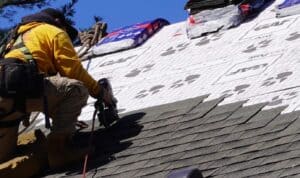
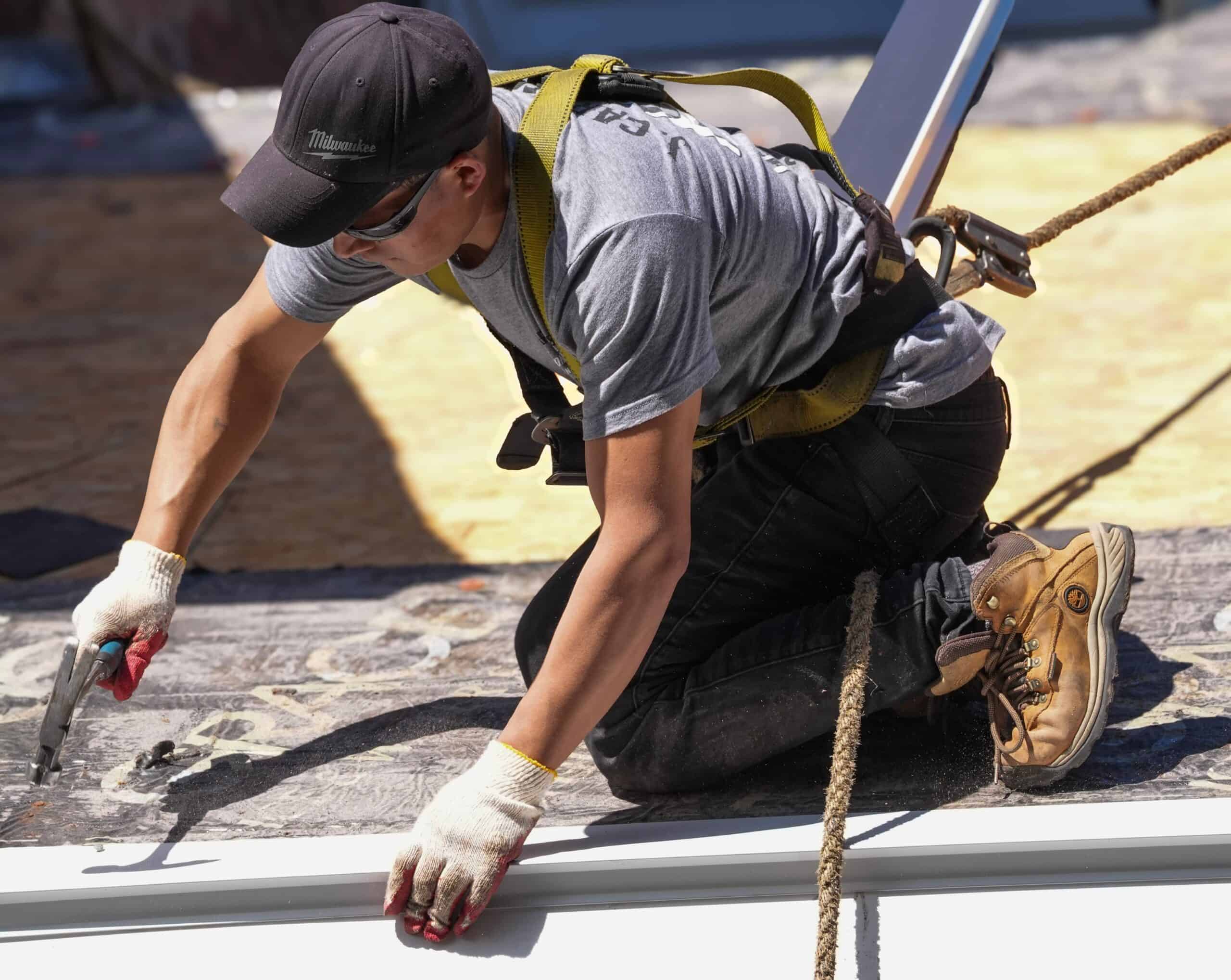
Safety tells you more than it seems to. A crew working in harnesses, tied off, with the site taped and the landscaping tarped, is a crew run by someone who sweats details. The same discipline that keeps a roofer clipped to an anchor is the discipline that gets six nails into every shingle in the wind zone instead of four. When we photograph our jobs, those harnesses are in the pictures because that is how the work actually gets done. If a crew is free-walking a two-story colonial roof, ask yourself what other corners look reasonable that day.
How can you spot a storm chaser?
After every named storm that crosses the Seacoast, they arrive. Trucks you have never seen, canvassing neighborhoods off Winnicutt Road and Union Road, offering free inspections and same-week starts. Some are legitimate. Enough are not that the pattern is worth knowing.
The tells are consistent. Urgency is the big one: prices that expire today, claims that your roof is an emergency after a ten-minute look. The insurance angle is another. A contractor who promises to get your whole roof paid for by insurance before an adjuster has seen it is writing checks your policy may not cash. And the deposit structure tells its own story. A modest deposit to schedule the work is normal business. Most of the money up front, from a company with no address you can drive to, is how people end up with a stripped roof and a dead phone number.
The counter to all of it is boring: hire somebody local enough to be accountable. A shop that has been on the Seacoast for years will still be here when your neighbor asks who did your roof. That is the accountability no contract clause can replicate.
What do the warranties actually cover?
Shingle manufacturers advertise long warranties, and homeowners hear those numbers as “my roof is covered for decades.” Read the fine print and the coverage is against manufacturing defects, which cause a small fraction of real-world roof failures. The leaks we get called to fix almost always come from installation details: flashing, fastening, ventilation, sealant. That is workmanship territory, and workmanship is warranted by the contractor, not the manufacturer.
So ask the question directly: if this roof leaks in year three because of how it was installed, what happens? You want the answer in writing, with a number of years attached. Also worth knowing: many manufacturer warranty tiers require correct installation and registration to reach their full terms, which loops right back to the quality of the contractor you pick. The warranty conversation and the workmanship conversation are the same conversation.
When should you get quotes, and how do you compare them?
The worst time to pick a contractor is with water coming through the ceiling, which is exactly when the least scrupulous operators do their best business. If your roof is past twenty years old, or the inspection habits we recommend for Seacoast homes have turned up granule loss or rusting fasteners, start the conversation while it is still a project instead of an emergency.
When the quotes come in, resist the urge to sort by price and pick the bottom. Line them up scope against scope. If one contractor is at a significantly lower number, the money came from somewhere: a lighter shingle line, reused flashing, no decking allowance, an uninsured crew. Sometimes the low bid is honest efficiency. Usually it is a difference you will find later, on your roof, in the rain. And if budget is the real constraint, say so out loud. There are legitimate ways to work with it, from material choices to financing, that beat quietly buying a thinner roof.
We are a family roofing company based in Hampton Falls, one town over, and we have been answering these exact questions for Stratham homeowners for years. If you are collecting quotes, we would like to be one of them. Reach out for a free estimate and put every question in this article to us. That is what they are for.
Frequently asked questions
How many roofing quotes should I get in Stratham?
Two or three from contractors you have already screened for insurance and local track record. More than that and the scopes get hard to compare honestly. The screening matters more than the count: three quotes from vetted local companies beat six from whoever knocked on the door.
Do I need a building permit to replace a roof in Stratham?
Re-roofing work in Stratham generally goes through the town’s building department, and pulling the permit should be the contractor’s job, not yours. Treat it as a screening question: a contractor who suggests skipping the permit to save time is telling you how they handle the parts of the job you cannot see.
How long does a roof replacement take?
Most single-family asphalt roofs on the Seacoast are done in one to three days once materials are on site, weather permitting. Complexity drives the range: steep pitches, multiple layers to strip, chimneys and valleys, and any decking replacement add time. Your quote should include an expected duration.
What time of year is best for roof work in New Hampshire?
Roofing runs from spring through late fall here, and asphalt shingles seal best with some warmth in the air. Late summer and early fall are the sweet spot on the Seacoast. Winter work is possible when a failure forces it, but planned replacements are easier to schedule, and often smoother, in the warmer months.